
2026
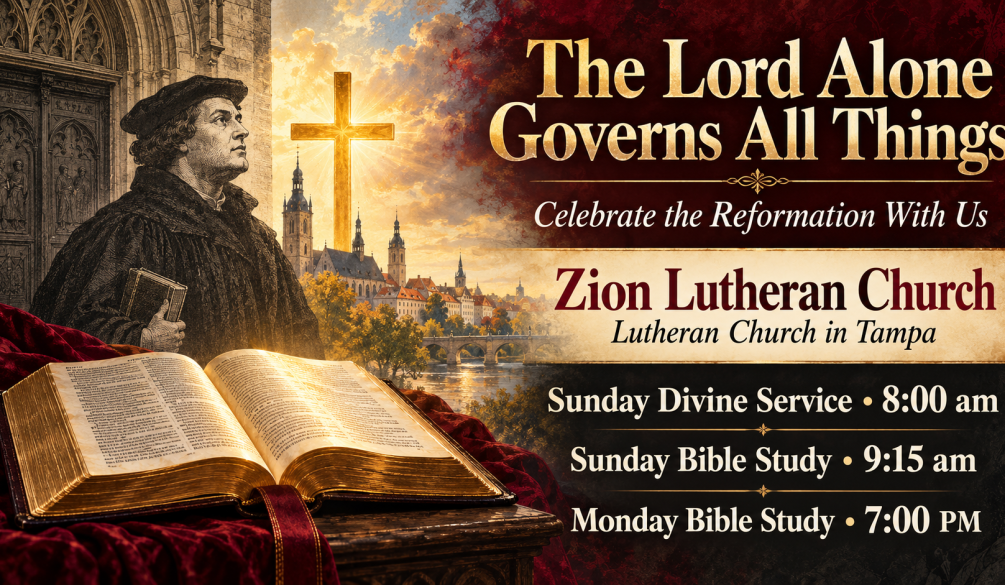
The Lord Alone Governs All Things
If you are looking for a Conservative Church in Tampa or a Lutheran Church in Tampa, Zion Lutheran Church invites you to hear the comfort and hope of God’s Word. In this sermon, Rev. Kenneth Redmann reflects on God’s rule over all things and the assurance that, through Christ, we belong to Him.
Oct 18 21PentAG Rev. Kenneth Redmann
Opening Prayer
May the meditations of our hearts and the words of my lips be acceptable to You, O Lord. Amen. In the name of the Father and of the Son and of the Holy Spirit. Amen.
The Lord Alone Is in Total Control
Today’s appointed readings combine to confront us with a truth that can be described as “mind-boggling.” God’s mysterious revealed truth is humbling and comforting. That TRUTH is: the Lord alone governs all things; or reigns over all things; or the Lord alone is in total control over all things at all times and under every circumstance. I know! I know! It is hard to believe.
Yet, as we shall see, God governs kings and nations, He governs history and time, He governs the lives of His people, AND He governs His Church universal and His local Church—yea, even Zion Evangelical Lutheran Church in Tampa Heights, FL.
And because He governs all things, Jesus teaches us to “render to Caesar the things that are Caesar’s, and to God the things that are God’s” (Matt 22:21).
But what belongs to God? The answer, drawn from Scripture and affirmed by the Church through the ages, is simple and profound: YOU belong to God.
I. We have said that: God Governs All Things—Even When It Surprises Us
Our Old Testament reading from Isaiah 45 is startling. Did you catch it? “Thus says the LORD to His anointed, to Cyrus…” (v1). Cyrus is a pagan king from Persia. YET, the Lord says to Cyrus: “I call you by your name, I name you, though you do not know me.” (Isa 45:4)
Cyrus does not worship the Lord. He does not know the Lord. Yet the Lord knows him, raises him up, and uses him to deliver His people.
So, here is the thumbnail sketch: Jerusalem has been decimated. Her walls of protection completely demolished. Her magnificent temple has been ransacked and desecrated. The seventy years of Babylonian captivity is drawing to an end. God is now raising up Cyrus, the King of Persia to overthrow Nebuchadnezzar, the King of Babylon—for the purpose of setting God’s Chosen People free and restoring them to Jerusalem.
Dare I say it? Bear with me, please. They are the original Remnant in Rebirth.
Beloved in the Lord, God’s sovereignty is not theoretical—it is concrete, historical, and sometimes very surprising.
The psalmist proclaims: “For great is the LORD, and greatly to be praised; he is to be feared above all gods” (Ps 96:4). The Lord reigns over all nations, all peoples, all rulers, all powers.
Paul writes to the Thessalonians that the Gospel came to them “not only in word, but also in power and in the Holy Spirit” (1 Thess 1:5). God governs not only kings and nations—He governs hearts.
In our Gospel lesson, Jesus reveals that God’s claim on us is ultimate. Caesar may have a legitimate claim on the coin that bears his image, but God has a far greater claim on the human being who bears His image—fractured as it now is.
II. And because of our fallen state, We Resist God’s Rule.
1. We want control over our lives.
Isaiah reveals God using Cyrus—someone Israel never would have chosen. God’s ways are not our ways (Cf Is.55:8-9). We prefer a God who works according to our expectations, who governs in ways we approve, who uses the people we would choose.
But God says: “I form light and create darkness; I make well-being and create calamity; I am the LORD, who does all these things.” (Isa 45:7)
We resist this. We don’t understand how a God of Love can “create calamity.” We want to be sovereign over our own lives.
2. All too often, we give to Caesar what belongs to God.
The hypocritical Pharisees try to trap Jesus with a political question. They want to force Him into choosing sides. Jesus refuses. Jesus acknowledges Caesar’s legitimate authority, (granted to Caesar by God in the first place), but Jesus refuses to let politics define the kingdom of God.
We often do the opposite. We let earthly loyalties overshadow our loyalty to God. We give our hearts, our fears, our hopes, our identity to earthly powers—things that belong to God alone.
3. We worship idols of the heart.
Psalm 96 declares: “For all the gods of the peoples are worthless idols.” (Ps 96:5)
Luther writes in the Large Catechism, “Whatever you set your heart on and put your trust in is truly your God.” Our idols may not be statues, but they are real: control, comfort, politics, money, reputation, self‑rule.
4. We fail to render ourselves to God.
The denarius bears Caesar’s image, and so it is rightly given back to Caesar. But we — human beings — were created to bear God’s image (Gen. 1:27). That image, in its proper sense, was original righteousness: true knowledge of God, fear of God, trust in God, and a will aligned with God’s will. Sadly, tragically, through the fall of Adam and Eve, that image was lost, and what remains in us now are only the damaged remnants of it — reason, will, and relational capacity, all bent inward by sin.
Instead of giving ourselves to God in trust and obedience, our corrupted nature clings to self-rule. We withhold from God what is rightfully His: our hearts, our worship, our lives, our gifts and talents. We were made to reflect His righteousness, but in our sin we render ourselves to anything and everything except Him.
III. In spite of the gravity of all of this—the Gospel reveals the astonishing truth: God Governs All Things for Our Salvation.
1. God governs HISTORY to bring salvation.
Our Old Testament lesson from Isaiah 45 shows God directing kings and nations so that His people may be saved. Francis Pieper writes that God’s providence is always directed toward the good of His Church. Even pagan King Cyrus becomes an instrument of God’s grace.
2. God governs the Gospel to reach us.
Paul says the Thessalonians “turned to God from idols to serve the living and true God” (1 Thess 1:9). They did not find God—God, through the Holy Spirit, found them. He turned them from idols to Himself.
3. God governs redemption through Christ.
Jesus does not merely teach ABOUT rendering to God—Jesus renders Himself to God FOR US. Jesus gives to the Father what we could never give: perfect obedience, perfect trust, perfect worship, perfect surrender.
Jesus bears the image of God perfectly (Col 1:15) and restores that image in us through His death and resurrection. Hear the Word of the Lord, “you [Christians] have put off the old self with its practices and have put on the new self, which is being renewed in knowledge after the image of its creator” (Col 3.10).
4. Dear brothers and sisters in Christ, God claims you as His own.
Because Christ has redeemed us, God says: “You are mine.” Luther writes in the Small Catechism that Christ “has redeemed me a lost and condemned creature… that I may be His own.” The Gospel is not merely that God governs all things—it is that He governs all things for the sake of His redeemed people.
IV. Sanctification: Therefore, We Render Our Lives to God
Sanctification, i.e. the living of our lives, flows from the Gospel—not from fear, pressure, or political anxiety, but from belonging to Christ.
1. We render worship to God alone.
“Ascribe to the LORD the glory due his name” (Ps 96:8). Because God reigns, worship becomes our joyful response—not a burden.
2. We render obedience to God in our vocations.
Jesus affirms legitimate earthly authority: “Render to Caesar the things that are Caesar’s.” Luther and the Confessions teach that Christians honor rulers as part of their vocation (Augsburg Confession XVI). But we obey God above all when earthly claims conflict with His Word.
3. We render witness to God before the world.
The Thessalonians became “an example” to all believers. Their faith “sounded forth” (1 Thess 1:7–8). Living our Christian faith is not private—it is visible.
4. We render ourselves to God daily.
Because we bear God’s image, we give Him our hearts, our decisions, our time, our resources, our vocations, our worship—our whole selves. Not to earn salvation, but because salvation is already ours.
5. And finally, we render trust to God in uncertain times.
The fact that God used the pagan, King Cyrus, teaches us that God works through unexpected means. We trust His governance even when we cannot see His plan. Another way to say this is, the Lord alone is in total control over all things at all times and under every circumstance.
Therefore: Render to Caesar what is Caesar’s. Render to God what is God’s. And remember—what is God’s is you.
God grant it for Jesus’ sake. Amen.
“For I know the plans I have for you,” declares the Lord, “plans for welfare and not for evil, to give you a future and a hope” (Jer 29.11 NIV).
Join Us for Worship and Bible Study
Find encouragement in God’s Word and join our church family at Zion Lutheran Church. You are invited to Sunday Divine Service at 8:00 am, followed by Bible Study at 9:15 am. We also welcome you to 7:00 PM Bible Study Mondays as we grow together in faith and understanding of Scripture.
Prepare for worship by downloading the October 25 Reformation Day worship folder. We look forward to welcoming you!
Zion Lutheran Church — A Christian Family Who Cares for You!
2026
Rejoice in the Lord Always
Oct 11 20PentAE Rev. Kenneth Redmann
Introduction
What does it mean to rejoice in the Lord always, even when life is difficult? In this sermon, Rev. Kenneth Redmann explores Philippians 4 and the lasting joy we find in Christ’s faithfulness, presence, and promises. As a Christian church in Ybor City, Zion Lutheran Church shares this comforting message: our circumstances change, but our Savior remains faithful. If you are looking for a Christian Church in Tampa, we invite you to discover the peace and hope found in His Word.
May the meditations of our hearts and the words of my lips be acceptable to You, O Lord. In the name of the Father and of the Son and of the Holy Spirit. Amen.
Beloved in Christ, today we arrive at the fourth sermon in our series on Paul’s letter to the Christians in Philippi. Before Paul gives us the famous imperative, “Rejoice in the Lord always,” he begins the chapter with a crucial word—one we often skip over.
Looking Back: God’s Providence and Our Strength in Christ
Philippians 4:1 — “Therefore…” Paul writes: Therefore, my brothers, whom I love and long for, my joy and crown, stand firm thus in the Lord, my beloved.”
“Therefore” is never a throwaway word. And it always points backward. It always asks: “Therefore what?”
So, before we move forward, we must take a look back. Paul is building on everything he has already taught us—everything we have explored in the first three sermons of our series. Let’s take a stole down memory lane, as they say.
In week one, Paul said, “I want you to know… that what has happened to me has really served to advance the gospel” (Phil 1:12).
Paul taught us that God’s PROVIDENCE governs all things, even chains, prisons, hardships, and suffering. We learned that God restrains all things—even evil—to serve His saving purpose (Cf: Gen 50:20; Rom 8:28).
Our Old Testament lesson that day recalled Joseph and his evil brothers. Joseph said, “you meant evil against me, but God meant it for good…” And we remembered one of the most famous verses in all of Holy Scripture, “And we know that for those who love God all things work together for good, for those who are called according to His purpose.”
Paul’s imprisonment became a pulpit. His suffering became a megaphone for Christ. Providence is not theoretical; it is personal, active, and always Christ‑centered.
In week two, Paul taught us that believers, redeemed by Christ, shine as lights in a dark world. Not because we are naturally bright, or that we have some “inner light”, but because Christ, who dwells in us, is the Light of the world (John 8:12).
The Bible says, “it is no longer I who live, but Christ who lives in me” (Gal 2.20).
In week 3, just last week we heard Paul’s breathtaking confession: “I count ALL THINGS as loss because of the surpassing worth of knowing Christ Jesus my Lord” (Phil 3:8).
And THEN, we heard his triumphant declaration: “I can do all things through Him who strengthens me” (Phil 4:13).
Paul’s “all things” is not a slogan of self‑empowerment. He is not pulling himself up by his bootstraps. It is a confession of Christ‑dependence. Christ is the One who strengthens. Christ is the One who enables and empowers. Christ is the One who carries His people.
A Command to Rejoice in the Lord Always
Today, having laid all that foundation, Paul now gives us a command: “Rejoice in the Lord always; again I will say, rejoice” (Phil 4.4).
Please notice, this is not a suggestion. Not a gentle encouragement. Not a “try your best.”
It is an imperative. A command, inspired by the Holy Spirit, for the apostle of Christ to deliver in no uncertain terms. And the command is intensified by the word “always.”
“ALWAYS?”
Beloved in the Lord, many of you are well aware that most marriage counselors warn couples against using absolute adverbs: You know, like:
- “You always do that.”
- “You never listen.”
- “You always forget.”
- “You never care.”
Why? Because “always” and “never” are rarely true. They exaggerate. They wound. They shut down conversation. They turn a moment into a verdict.
But here Paul uses the absolute adverb: “always”. And he uses it very intentionally. Because the command is not:
“Rejoice in yourself always.” “Rejoice in your circumstances always.” “Rejoice in your achievements always.” The command is: “Rejoice in the LORD always.”
And the LORD is always faithful. Always present. Always merciful. Always victorious.
Therefore, the command is not burdensome. It is liberating.
Let Christ’s Gentleness Be Seen in You
And with this Christ-filled freedom, Paul continues: “Let your reasonableness be known to everyone. The Lord is at hand” (Phil 4: 5).
I was fascinated with the word, “reasonableness.” The Greek word here is ἐπιεικές (ep-e-a’-kas). One of my seminary profs, Dr. Weinrich, would famously say, the word is “pregnant” with meaning. The Theological Dictionary of the New Testament, notes that the term carries a constellation of ideas:
- Gentleness, forbearance
- Graciousness, patient restraint
- the willingness to yield personal rights for the sake of love
Different Bible translations try to capture this richness:
- ESV: reasonableness (English Standard Version),
- NIV: gentleness (New International Version)
- NASB: gentle spirit (New American Standard Bible)
- KJV: moderation (King James Version)
- Or the paraphrase: God’s Word Translation: how considerate you are
So, which translation is correct? Answer: All of the above!
Paul wants to be like Christ (Phil 3:10). He wants Christ’s gentleness to be seen in him. And he wants Christ’s gentleness to be seen in every believer. This is the fruit of the Spirit (Gal 5:22–23). This is the character of Christ who formed and who is dwelling in His people.
Clothed in Christ’s Righteousness
But here we must pause.
Because while all believers strive for this Christlike gentleness… We fail. We fall short. We are sinful by nature. Our old Adam takes over and we do what we do not want to do—we do what we hate! (Rom 7.15).
Jesus Himself gives us a sobering illustration of this truth. The parable of the wedding feast is one of Jesus’ most severe warnings.
The King prepares a lavish banquet—symbolizing the salvation feast of Isaiah 25:
“On this mountain the LORD of hosts will make for all peoples a feast of rich food… He will swallow up death forever” (Is 25:6–8).
But in Jesus’ parable, of those who were invited, i.e., those Chosen People, some refuse the invitation, some make light of it and some are downright hostile. Therefore, the “outcasts” are invited. They were gathered up, those who had no standing, no social graces and, certainly, no one who deserved such a lavish free feast.
And then, the pinnacle of the parable: One man enters without the wedding garment. That is to say, one man entered who REFUSED to receive his robe of righteousness that the King had provided. The wedding garment symbolizes Christ’s righteousness (Rev 7:14). It is the garment of salvation (Is 61:10). It is the covering God Himself provides.
Be assured, the man was offered the free gift of righteousness. The tragedy is that he refused the righteousness so freely offered. This is the warning: We cannot enter God’s feast clothed in our own goodness, our own gentleness, our own (ep-e-a’-kas). We must be clothed in Christ. Luther put it this way, “The wedding garment is Christ Himself, whom we put on in Baptism.” (Martin Luther, Sermon on Matthew 22 (1522), WA 10/3:214)
The Lord Is at Hand: Our Comfort and Confidence
Which brings us to Paul’s next phrase, which could be called the “anchor of the passage.” Paul says, “The Lord Is at Hand” (Phil 4.5) The LORD is our Comfort and our Confidence.
This is why we can rejoice always. This is why we can be gentle. This is why we need not be anxious. This is why we can pray with thanksgiving.
The Lord is near in His incarnation. He is near in His Word. He is near and REAL in His Sacraments. He is near in His coming again.
Beloved in the Lord, “The LORD is my shepherd; I shall not want.” “He restoreth my soul.” “Yea, though I walk through the valley of the shadow of death, I will fear no evil.”
Psalm 23 is not sentimental poetry. It is divine reality. It is Christ’s present-tense care for His people.
Isaiah 25 expands the picture: The Lord prepares a feast. He swallows up death forever. He wipes away tears from ALL faces. The Revelation puts it this way: “For the Lamb in the midst of the throne will be their shepherd… and God will wipe away every tear from their eyes” (7.17)
Do you see it? Do you hear it? From Psalm 23 to Isaiah 25 to Revelation 7, Scripture sings one sweet verse: The Lord is at hand. The Lord is near. The Lord is with His people.
The Same Christ, the Same Promises, the Same Strength
This is the lesson that Paul learned and embraced and lived out in his Christian journey. Paul’s life is not an exception. It is an example.
Paul writes: “I can do all things through Him who strengthens me” (Phil 4:13).
Paul is not boasting. Paul IS confessing. And the point is this:
Yes! The Lord worked in amazing ways in Paul’s life. So also, hear the Word of the Lord for YOUR life: For we are his workmanship, created in Christ Jesus for good works, which God prepared beforehand, that we should walk in them (Eph 2.10).
Not identically. Not with the same circumstances. Not with the same calling.
But, in YOUR vocation, in your journey with the same Christ. The same Spirit. The same promises. The same strength and conviction.
Paul’s peace is our peace. Paul’s Shepherd is our Shepherd. Paul’s feast is our feast. Paul’s Savior is our Savior. Paul’s joy is our joy.
Lasting Joy Rooted in Christ
This joy is not shallow. This is not a “happy face.” Rather, this joy is a deep-seated joy and contentment rooted in Christ crucified, risen, reigning, and returning.
Dear Christian, Rejoice in the Lord always. Again, I will say, rejoice.
God grant it for Jesus’ sake. Amen.
For I know the plans I have for you,” declares the Lord, “plans to prosper you and not to harm you, plans to give you hope and a future.[1]
Find Lasting Joy in Christ
“Rejoice in the Lord always” is more than an encouraging phrase. It is an invitation to rest in the Savior who strengthens us, clothes us in His righteousness, and remains near through every season. Our joy is rooted in Christ and His promises, giving us comfort even when life feels uncertain.
If you are seeking a Christian church in Ybor City, we invite you to worship, learn, and grow with us. Come discover a Christian Church in Tampa where we share God’s Word, encourage one another, and welcome you into a church family.
We invite you to join us this Sunday. Sunday Divine Service at 8:00 am, followed by Bible Study at 9:15 am. 7:00 PM Bible Study Mondays. You may download the worship folder here.
Zion Lutheran Church — A Christian Family Who Cares for You!
[1] The Holy Bible: New International Version (Je 29:11). (1984). Zondervan.
2026
All Things
Rev. Kenneth Redmann
For those seeking a Conservative church in Tampa or a Christian church in Tampa, this sermon reflects on the surpassing worth of knowing Jesus Christ. In Part III of this series on Philippians, Rev. Kenneth Redmann explores:
- What Paul counted as loss for the sake of Christ.
- The warnings found in Isaiah’s vineyard and Jesus’ parable of the tenants.
- What Christ willingly lost for our salvation.
- The lasting hope and inheritance we have in Him.
Part III: Paul’s Letter to the Philippians
4Oct 19PentAE “All Things” Rev. Kenneth Redmann
May the meditations of our hearts and the words of my lips be acceptable to You, O Lord. In the name of the Father and of the Son and of the Holy Spirit. Amen.
Beloved in the Lord, this morning we have Part III of our four-part series on Paul’s letter to the Christians at Philippi. Today, the Word of God confronts us with a phrase that is both unsettling and comforting, both devastating and life‑giving. It is the phrase Paul uses, inspired by the Holy Spirit, in Philippians 3: “For His sake I have suffered the loss of all things and count them as rubbish, in order that I may gain Christ” (v 8b).
“All things.” It is a phrase that forces us to ask: What would I lose for Christ? What have I clung to instead of Christ? And what did Christ lose for me?
Our readings today—Isaiah’s Song of the Vineyard, Jesus’ parable of the wicked tenants, and Paul’s confession and testimonial in Philippians—press this theme upon us with holy urgency.
Counting All Things as Loss for Christ
Last week we introduced Harlyn Kuschel, the author of the People’s Bible Commentary on Philippians. Kuschel notes that Paul begins with a spiritual résumé that, would have impressed any first‑century Jew. Paul lists his heritage, his training, his zeal, his righteousness under the Law. If anyone could claim spiritual achievement, Paul could.
But then comes the earthquake, Paul says, “But whatever gain I had, I counted as loss for the sake of Christ.” (Phil 3:7)
And again: “Indeed, I count everything as loss because of the surpassing worth of knowing Christ Jesus my Lord.” (Phil 3:8)
Paul is waging a counter attack against the Judaizers who were tormenting the Christians in Philippi. Please note: the Judaizers claimed to believe in Jesus but they insisted one must also keep certain Laws of Moses to be saved. Luther says that the Judaizers destroy the Gospel by adding works. “The doctrine of the Judaizers was this: Faith in Christ is not enough; works of the Law must be added. This is to lose Christ altogether.” (Martin Luther, Lectures on Galatians (1535), LW 26:88)
Paul is not merely saying that Christ is more valuable than other things. Paul is saying that Christ is so valuable that everything else becomes worthless in comparison.
Kuschel emphasizes that Paul’s imprisonment sharpened this conviction. Stripped of freedom, reputation, and safety, Paul realized that Christ alone remained—and Christ alone was enough.
For Paul, “all things” were not just worldly possessions. They were the very things he once believed made him righteous. And now, Paul says they are rubbish—garbage—compared to Christ.
What Are the “All Things” We Cling To?
Beloved in the Lord, I need to ask, “What are the ‘all things’ we cling to? What do we secretly believe makes us righteous? Our reputation? Our accomplishments? Our moral record? Our theological correctness? Our service? Our family heritage?”
Paul says: All of it must die. All of it must be counted as loss. All of it must be surrendered.
Not because these things are evil, in and of itself, but because none of them can save.
Isaiah’s Song of the Vineyard
Isaiah’s Song of the Vineyard is a sad and graphic depiction of what happens when God’s people refuse to surrender all things to Him. God planted Israel with care—“He dug it and cleared it of stones,” “He built a watchtower,” “He hewed out a wine vat.” He gave His Chosen People all things needed for faith and life.
But when He looked for grapes, He found only wild grapes.
And so God said: “I will remove its hedge… I will break down its wall… I will make it a waste.” (Isa 5:5–6)
Israel loses all things—protection, blessing, fruitfulness—because they refused the one thing needed: faithfulness to the Lord.
Luther often preached that Israel’s downfall was not ignorance but arrogance. They believed they could keep God’s blessings while rejecting God’s Word. They wanted the vineyard without the Vinedresser.
Isaiah warns us: If we cling to our own righteousness, our own achievements, our own identity, we will lose all things.
Jesus’ Parable of the Wicked Tenants
Jesus’ parable intensifies the warning. The tenants were entrusted with a vineyard—again, all things needed for life and fruitfulness. But when the owner sent servants to collect fruit, they beat, stoned, and killed them. Finally the master sent his son.
You know what happened. They killed him too.
The Bible says: “He [the master] will put those wretches to a miserable death and let out the vineyard to other tenants.” (Matt 21:41)
They lose all things—the vineyard, the blessing, the inheritance—because they rejected the Son.
C.F.W. Walther puts it this way, “He who rejects Christ must bear the full weight of the Law’s curse. There is no wrath more dreadful than the wrath that falls on those who despise the Gospel.” (C. F. W. Walther, Law & Gospel, Thesis VIII)
But the parable also prepares us for the Gospel. Because the Son who is killed becomes the cornerstone. The One who loses all things becomes the foundation of all things ETERNAL!
Christ Lost All Things for Our Salvation
Thus we reach the heart of the Gospel. Paul says he lost all things for Christ. Israel lost all things because of unbelief. The tenants lost all things because they killed the Son.
But Christ—Christ alone—lost all things willingly, lovingly, savingly.
He lost His glory, taking the form of a servant. He lost His honor, being mocked and rejected. He lost His friends, abandoned by all. He lost His comfort, sweating, as it were, drops of blood in Gethsemane. He lost His dignity, spit upon, stripped and beaten. He lost His strength, collapsing under the weight of the cross. He lost His life, crucified for sinners. “Father, forgive them for they know not what they do” (Luke 23.34 ESV).
Jesus lost all things so that you and I might gain all things.
Luther says that Christ became the greatest sinner—not by committing sin, but by bearing the sin of all—so that we might become the righteousness of God. Hear the words of Luther from his sermon on the Baptism of Jesus:
“He is the greatest sinner, who has and bears the sin of the world… He thus becomes a great sinner—indeed, the greatest sinner of all and the only sinner on earth—so that there is no other.” (https://witness.lcms.org/2017/christ-becomes-greatest-sinner/?utm_source=copilot.com)
Dear brothers and sisters in Christ, did you hear that? Jesus became the “only sinner on earth” so that you and I are no longer counted as sinners in God’s eyes. How amazing is that?
Gaining Christ and Pressing On Toward the Goal
For Paul, Christ does not merely replace what Paul lost. Christ becomes Paul’s treasure, Paul’s righteousness, Paul’s life. Therefore, Paul says: “That I may gain Christ and be found in Him.” (Phil 3:8–9)
And then Paul says something astonishing: “I press on toward the goal for the prize of the upward call of God in Christ Jesus.” (Phil 3:14)
Now be careful here! It sounds like we must do something for our salvation. To preserve our salvation. To add to what Christ has done for our salvation. No! Luther says;
“We do not become righteous by doing righteous deeds, but having been made righteous, we do righteous deeds.” (Martin Luther, Disputation Concerning Justification (1536), LW 34:152)
Paul presses on not because he is strong, but because Christ is strong in him. Kuschel notes that Paul’s imprisonment sharpened his focus on the resurrection. The loss of all earthly things made the heavenly prize shine brighter.
That’s the thing about our Christian journey: We lose all things that cannot save. But we gain Christ who saves completely. And then Christ begins His work in us. Hear the Word of the Lord: “For we are His workmanship, created in Christ Jesus for good works, which God prepared beforehand, that we should walk in them” (Eph 2.10 ESV).
Christ shapes us. He forms us. He conforms us to His image. He teaches us to count all things as loss. He teaches us to press on. He teaches us to live by faith.
If You Have Christ, You Have All Things
Beloved in the Lord, we may lose earthly things—status, comfort, reputation, possessions. We may lose things we once thought essential. We may lose things we never wanted to surrender.
But you will never lose Christ. And if you have Christ, you have all things.
The vineyard is yours. The inheritance is yours. The resurrection is yours. The righteousness of Christ is yours. The upward call is yours. The kingdom is yours.
All this because Christ Himself is yours.
God grant it for Jesus’ sake. Amen.
And the peace of God that passes all understanding will keep your hearts and minds in Christ Jesus. Amen.
Find Hope and Fellowship in Christ
Christ’s promises give us hope through every earthly loss. If you are looking for a Conservative church in Tampa or a Christian church in Tampa, we invite you to join us for worship, hear God’s Word, and grow in faith alongside a caring congregation.
A Christian Family Who Cares for You!
2026
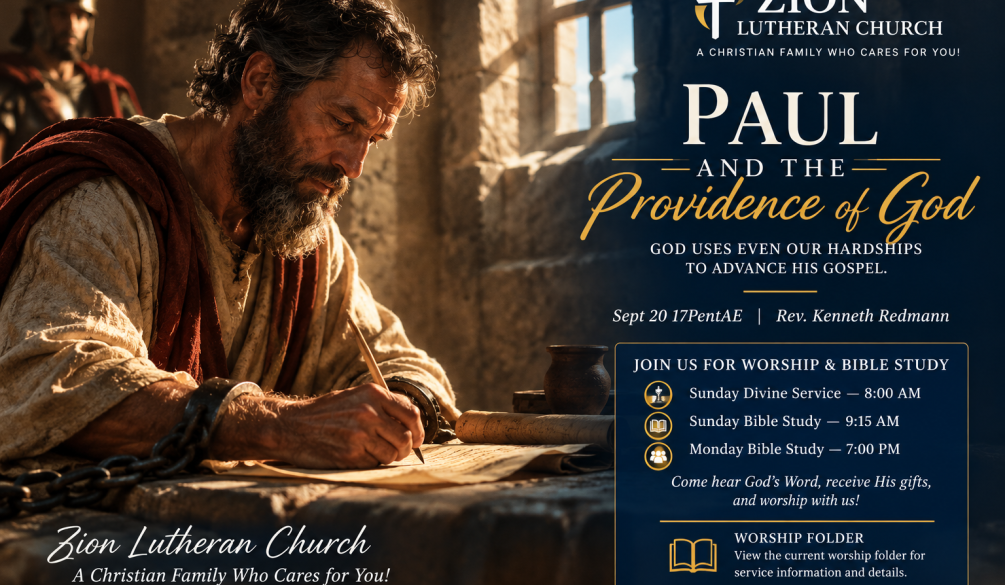
Paul and the Providence of God
If you are searching for an LCMS Lutheran Church in Tampa or a Conservative Church in Tampa, Zion Lutheran Church welcomes you to explore the Word of God with us. In this sermon, Rev. Kenneth Redmann reflects on Paul, suffering, Christian steadfastness, and the Providence of God through the opening chapter of Philippians. As Paul discovered, even difficult circumstances can serve the advancement of the Gospel according to God’s providential care.
Sept 20 17PentAE Paul
May the meditations of our hearts and the words of my lips be acceptable to You, O Lord. In the name of the Father and of the Son and of the Holy Spirit. Amen.
Dear brothers and sisters in Christ, dear Remnant in Rebirth, last week we stood with Joseph in Genesis 50:20 and heard him proclaim: “You meant evil against me, but God meant it for good.” And in one of the most widely quoted verses in all of the Bible, we hear Paul, inspired by the Holy Spirit, echo the same truth in Romans 8:28: “And we know that for those who love God all things work together for good, for those who are called according to His purpose.”
Today, we begin a four‑week journey through the appointed Epistle readings. In doing so, we will discuss the entire letter that Paul, inspired by the Holy Spirit, wrote to the young Christians in Philippi.
Our theme for today is, Paul and the Providence of God. The Providence of God? Yes. And you may well ask, “What exactly is the Providence of God?” Turns out, that is a really critical question!
I asked Google! You know, Google knows everything!
Google said that the Providence of God is: the foreseeing care, guidance, and benevolent superintendence which God exercises over the universe and all human beings. And I am like: O-K-A-Y!
Francis Pieper, in his Christian Dogmatics, does NOT so much define the Providence of God as much as he describes it.
God, who created the world, also preserves it. Colossians 1:16-17: All things were created by Him…and in Him all things hold together (ESV). We call this act, … the divine Providence, which means that God actually preserves and governs the universe and ALL individual creatures. (Christian Dogmatics, 1953, electronic ed., Vol 1, pp. 481. CPH).
Pieper goes on to explain:
After creating the world, God did not withdraw from it, …but He remains in contact with the world and sustains everything in it, the greatest and the least, by His divine power. … If God would desert the world, it would at once disappear. If God would withdraw His presence from any part of the world, that part would cease to exist.
Thus, Paul understood that God remains intimately engaged in the world to work all things to the glory of His Kingdom. God does not desire that one (not one!) created one should perish.
Thus we see the Providence of God shining through the chains of the Apostle Paul. In Philippians 1:12, Paul begins his letter with a stunning declaration: “I want you to know, brothers, that what has happened to me has really served to advance the gospel.” (ESV)
What has happened to him? Arrest. Imprisonment. Trial. Uncertainty. Hardship. Suffering.
Yet Paul says it has really served to advance the gospel.
Today we ask: Why is Paul so steadfast? What does Paul understand that makes him rejoice in chains? What does he know about Jesus that compels him to serve with his whole life?
And then we ask: What does this mean for us — the Remnant in Rebirth — a 100‑year‑old mission start, small in number but rich in heritage, called anew to the work of the Gospel?
I. In pondering Paul and the Providence of God, Scripture interprets Scripture and our readings from Isaiah and Matthew Set the Stage
(A. Isaiah 55: God’s Ways Are Higher)
Our Old Testament reading lays the foundation:
“Seek the LORD while he may be found… For my thoughts are not your thoughts, neither are your ways my ways, declares the LORD.” (Isaiah 55:6, 8 ESV)
God’s ways are higher — higher in mercy, higher in grace, higher in generosity. You know, we recite it every Sunday. Exceeding abundantly above all that we ask or think or imagine—higher! This is the theological soil in which Paul’s confidence grows.
(B. Matthew 20: The Generous Master)
Jesus’ parable of the laborers in the vineyard reveals the heart of God’s providence. Some work ALL day. Some work only one hour. Yet the master gives the same wage to all.
The point is not fairness. The point is grace. The point is God’s sovereign freedom to be generous. The point is God’s providence, which gives not according to merit but according to mercy.
This is what Paul understands. This is why Paul is steadfast. This is why Paul is willing to suffer, to endure, to die.
Paul has come to know the generosity of God in Christ. He knows that everything — chains included — comes from the hand of a gracious Master.
(II. Paul’s Captivity: The Historical Setting)
Theologian, Harlyn Kuschel, in his People’s Bible Commentary on Philippians, helps us understand Paul’s circumstances. Paul is imprisoned, likely in Rome but possibly in Caesarea. Wherever he is, he is under house arrest, chained to Roman guards, awaiting trial before Caesar. His future is uncertain. He may be set free. He may be executed.
Yet Kuschel emphasizes that Paul is not discouraged. He is not defeated. And he certainly is not silenced.
Instead, Paul sees his imprisonment as part of God’s providential plan. The guards hear the Gospel. Visitors hear the Gospel. Roman Christians are emboldened. The Gospel spreads in ways it never would have if Paul were free.
Paul’s chains become Christ’s pulpit.
This, then, is one example of the astonishing reality of God’s Providence: God uses suffering to advance His saving purpose.
(III. Paul’s Unwavering Devotion to Christ)
Paul’s words in Philippians Chapter 1, reveal a man utterly captivated by Christ. He writes:
“It is my eager expectation and hope that I will not be at all ashamed… For to me to live is Christ, and to die is gain.” (Philippians 1:20–21 ESV)
This is not stoicism or bravado. This is not fatalism or resignation.
This is faith — faith in the crucified and risen Lord who loved Paul first.
(A. Luther: Life Under the Cross)
Luther teaches that the Christian life is lived under the cross — the Church Militant. Suffering is not a sign of God’s absence but of His work. Paul’s chains are not obstacles; they are instruments. Suffering is part of the battle Christ wages through His Church.
(B. Pieper: Providence and Preservation)
Pieper emphasizes that God’s Providence is not abstract. It is personal. It is purposeful. It is directed toward the salvation of all people and the preservation of His Church.
Paul’s imprisonment is not an accident. It is not a failure. It is not a defeat.
It is God’s providential means of advancing the Gospel.
(C. Walther: The Gospel Produces Courage)
Walther teaches that the Gospel — not the Law — produces Christian courage. The Law can and does terrify, accuse, expose — but it cannot empower and it certainly does not encourage. Paul’s strength comes from the Gospel: Christ died for him. Christ forgave him. Christ redeemed him. Christ called him. Christ promised him eternal life.
This is why Paul is unwavering. This is why Paul is determined. This is why Paul is willing to die.
He knows what Jesus has done for him. Do you get it?
(IV. Paul’s Suffering as Sanctification)
Paul writes: “I want you to know… that what has happened to me has really served to advance the gospel.” (Philippians 1:12 ESV)
Paul’s suffering is not wasted. It is not meaningless. Paul’s suffering has a purpose. Individually, it is shaping Paul into the image of Christ. But more than that, his suffering is a powerful witness and testimony.
(A. Paul’s Chains Inspire Others)
“Most of the brothers… are much more bold to speak the word without fear.” (Philippians 1:14 ESV)
Paul’s suffering strengthens the Church. His endurance emboldens others. His faith inspires courage.
(B. Paul’s Life Is Christ)
For Paul, “To live is Christ.” (Philippians 1:21 ESV) Beloved in the Lord, Christ is living in Paul. Christ is shaping and molding and forming Paul. Christ is empowering Paul. So much so, that Paul confesses, “To die is gain.” (Philippians 1:21 ESV)
This is sanctification’s final fruit: A heart so anchored in Christ that death is not loss but victory.
Dear brothers and sisters, we are not imprisoned like Paul. We are not chained to guards. We are not awaiting trial before Caesar.
But we are called to the same steadfastness. We are called to the same devotion. We are called to the same mission.
Like the early Christians in Philippi, we are small in number but rich in calling.
I certainly do not discount that we face discouragement. We face uncertainty. We face spiritual fatigue. But God’s Providence is at work in us. God’s grace is poured out on us. God’s mission is entrusted to us.
Like Paul, we say: “To live is Christ.” Paul’s chains advanced the Gospel. Our challenges can do the same. Paul’s suffering strengthened the Church. Our endurance can do the same. Paul’s unwavering devotion glorified Christ. Our steadfastness can do the same.
Because God’s ways are higher. Because God’s grace is generous. Because God’s Providence is perfect. Because Christ’s love is first — and greatest—we boldly proclaim, “To live is Christ”!
God grant it for Jesus’ sake. Amen.
16 For by him all things were created, in heaven and on earth, visible and invisible, whether thrones or dominions or rulers or authorities—all things were created through him and for him. 17 And he is before all things, and in him all things hold together.[1]
[1] The Holy Bible: English Standard Version (Col 1:16–17). (2025). Crossway Bibles.
Join Us at Zion Lutheran Church
If you are searching for a Conservative Church in Tampa or an LCMS Lutheran Church in Tampa, we invite you to join us at Zion Lutheran Church in Downtown Tampa for worship and Bible study.
Sunday Divine Service — 8:00 AM
Sunday Bible Study — 9:15 AM
Monday Bible Study — 7:00 PM
You can view the current worship folder here: Worship Folder.
We invite you to come hear God’s Word, receive His gifts, and worship with us.
Zion Lutheran Church — A Christian Family Who Cares for You!
2026
Forgiven to Be Forgivers
Introduction
What does it mean to be forgiven—and then to forgive others?
For Christians, forgiveness begins with the immeasurable forgiveness we have received from God through Jesus Christ. In Matthew 18, Peter asks Jesus how often he should forgive someone who sins against him. Jesus’ answer points us toward the heart of the Christian life: because we have been forgiven by God, we are called to forgive others.
If you are searching for a Lutheran church near me in Tampa, we invite you to explore what God’s Word teaches about forgiveness, mercy, and the saving grace of Jesus Christ. In his September 13 sermon, Rev. Kenneth Redmann examines Joseph’s forgiveness of his brothers, Jesus’ parable of the unforgiving servant, and the mercy of God proclaimed in Psalm 103.
We are forgiven to be forgivers.
Peter’s Question About Forgiveness
May the meditations of our hearts
and the words of my lips be acceptable to You, O Lord. In the name of the
Father and of the Son and of the Holy Spirit. Amen.
Beloved in the Lord, there is a
reason Peter asks Jesus the question he does in Matthew 18: “Lord, how often
will my brother sin against me, and I forgive him? As many as seven times?”
(v 21). Putting the best construction on it, Peter is not being stingy. A case
can be made that Peter is actually being generous by human standards. Afterall,
the rabbis taught that extending forgiveness three times was enough. Peter more
than doubles it.
However, Peter’s question reveals
something deeper: by nature, we do not want to forgive too often or too much.
We want limits. We want boundaries. We want to protect ourselves from being
hurt again. And if we are honest, we want to keep a little record of wrongs—just
in case.
But Jesus will not let Peter stay
there. Jesus will not let us stay there. Because forgiveness is not merely a
moral duty; it is the very character of the Christian life. It flows from the
heart of God Himself. And unless we understand the enormity of God’s
forgiveness toward us, we will never be able to forgive others rightly.
Today, God gives us three powerful
texts to teach us this truth: Joseph forgiving his brothers in Genesis 50,
Jesus’ parable of the unforgiving servant in Matthew 18, and the sweeping mercy
of God revealed in Psalm 103. Together they form a single message:
We are forgiven—so that we may be
forgivers.
Joseph Forgives His Brothers
Do you remember Joseph? Our text in
Genesis 50 places us at the end of Joseph’s long and painful journey. You
remember that his brothers once hated him, betrayed him, and sold him into
slavery! Now they desperately fear that Joseph will finally take revenge. The
Bible says, “It may be that Joseph will hate us and pay us back for all the
evil that we did to him” (v 15).
Their fear is understandable. They
deserve judgment. They deserve retaliation. And Joseph deserves justice.
But Joseph does something
astonishing. He weeps. He comforts. He speaks kindly to them. Joseph forgives
his brothers!
“Do not fear, for am I in the
place of God? … So do not fear; I will provide for you and your little ones”
(v 19, 21).
Joseph forgives because Joseph
knows God. Joseph forgives because Joseph has lived under God’s mercy. Joseph
forgives because Joseph understands that God has turned evil into good.
Joseph is not naïve. He does not
pretend their sin was small and inconsequential. He does not minimize the agonizing
pain he felt. He does not excuse their blatant betrayal. Joseph, if you will,
says the quiet part out loud: “You meant evil against me” (v 19). But
then Joseph explains God’s sovereignty: “But God meant it for good” (v 20).
This is right
forgiveness—forgiveness grounded in God’s mercy, not human sentiment.
Forgiveness that flows from faith. Forgiveness that sees God’s hand even in
suffering. Forgiveness that refuses to sit in the place of God.
Joseph shows us what forgiveness
looks like when we surrender in repentance and cry out to God for a new heart,
a clean heart, a pure heart that is shaped by grace. With David we pray, “Create
in me a clean heart, O God, and renew a right spirit within me (Ps 51.10).
The Enormity of God’s Forgiveness
Peter, however, has not yet come to
comprehend such Godly forgiveness. And the question for us this morning, “Have
we come to understand the enormity of God’s forgiveness?”
Peter wants a number. He wants a
limit. He wants to know when do we declare, “enough is enough!”
But Jesus answers him with a parable that explodes every human calculation. In
our Monday evening Bible class, we have examined the meaning of “hyperbole.” Hyperbole
is when we use extreme exaggeration to make a point. Jesus uses hyperbole in
His parable.
A servant owes his king ten
thousand talents—an impossible debt, a sum so large it cannot be repaid in a
thousand lifetimes. This is Jesus’ way of showing the enormity of our sin
before God.
And yet, in our parable, the king
forgives the entire debt. He releases the servant. He wipes the ledger clean.
He shows mercy beyond measure or human comprehension.
And then—that same forgiven servant
goes out and finds a fellow servant who owes him one hundred denarii—a small
debt, a few months’ wages. The first servant seizes him, chokes him, and
demands payment. He refuses mercy. He refuses patience. He refuses forgiveness.
Fellow servants reported the entire
episode to the king. The king’s judgment is swift and severe: “I forgave you
all that debt… And should not you have had mercy…?” (v 32. 33)
Jesus ends the parable with a
warning: “So also my heavenly Father will do to every one of you, if you do
not forgive your brother from your heart” (v 35). Jesus’ warning puts us in
mind of the Prayer that Jesus taught us to pray, in part, the Fifth Petition of
the Lord’s Prayer, “Forgive us our trespasses as we forgive those who
trespass against us.”
This is not works-righteousness.
Luther is clear in his Large Catechism: “Forgiveness is not earned by our
forgiving, but is given freely for Christ’s sake” (Large Catechism,
III.88).
Dear Christians, refusing to
forgive contradicts faith. It reveals a heart that has not fully embraced God’s
mercy. The unforgiving servant is not condemned because he failed to perform a
work. He is condemned because he despised God’s super-abundant grace.
Forgiven to Be Forgivers
Our theme this morning is,
“Forgiven to Be Forgivers.” How do we become forgivers? How do we forgive
seventy times seven? How do we forgive from a pure and clean heart?
The answer is found in Psalm 103—a
psalm that lifts our eyes to the enormity of God’s forgiveness.
“Bless the LORD… who forgives
all your iniquity” (v 1, 3). Not some. Not most. ALL.
“He does not deal with us
according to our sins” (v 10). “As far as the east is from the west, so
far does he remove our transgressions from us” (v 12).
Beloved in the Lord, SUCH is the
measure of God’s forgiveness. Infinite. Boundless. Complete.
“As a father shows compassion to
his children, so the LORD shows compassion…” (v13).
God forgives because He is
compassionate. God forgives because He knows our frame. God forgives because He
remembers that we are poor sinful creatures.
This is the forgiveness that Joseph
demonstrated. This is the forgiveness Peter is growing and learning to
understand. This is the forgiveness the unforgiving servant despised. And this
is the forgiveness that shapes the character of our lives as Christians.
Forgiveness and the Christian Life
World acclaimed Lutheran theologian,
Francis Pieper also insists that we are forgiven to be forgivers. Pieper
writes, “Faith which receives forgiveness is never alone; it is always
accompanied by renewal.” (Christian Dogmatics, II:558)
This renewal includes forgiving
others. Which is why Luther writes: “Where the heart is right with God… it
is impossible for it not to forgive.” (Large Catechism, III.92)
Do you get it? When Jesus warns
that the unforgiving will not be forgiven, He is not teaching salvation by
works. He is teaching that refusing to forgive is evidence of unbelief.
Refusing to forgive is a rejection of God’s abundant grace.
Therefore, forgiveness is both a
gift and a calling. We forgive because Christ forgave us. We release others
because God, through Christ, has released us. We show mercy because God
showered His mercy upon us through His only-begotten Son, Jesus.
What Does This Mean?
Today, we have been talking about:
Forgiven to Be Forgivers.
So, the famous Lutheran
question, “What does this mean?” I’m glad you asked! We start with:
·Forgiveness not optional. It is the shape of the Christian life.
·Forgiveness flows from faith, not human strength. We forgive because we have been forgiven
·Forgiveness is witness. When we forgive, we proclaim the God who forgives all our iniquity.
·Forgiveness is freedom. Unforgiveness binds; forgiveness releases.
·Finally, forgiveness is possible—even when it feels impossible—because God does not ask
us to give what He has not already given to us.
We forgive because Christ has
removed our transgressions as far as the east is from the west.
Peter asked for a number. Jesus
gave him a story. The unforgiving servant shows us what happens when we, on the
one hand, receive God’s super-abundant grace and then, on the other hand refuse
to grant forgiveness to our brother and sister. Psalm 103 shows the heart of
God who forgives all our iniquity. And Joseph shows us what forgiveness looks
like.
Beloved in the Lord, let us rejoice
that our debt is paid, our sins forgiven, our transgressions removed. Let us go
forth as people who forgive—freely, generously, from the heart—because we have
been forgiven by the God whose mercy is from everlasting to everlasting.
God grant it for Jesus’ sake. Amen.
The Lord is merciful and gracious, slow to anger and abounding in steadfast
love (Ps 103.8). Amen.
Conclusion
Forgiveness begins with the mercy of God. Through Jesus Christ, our debt is paid, our sins are forgiven, and our transgressions are removed. Because we have received such abundant mercy, we are called to live as people who forgive.
We are forgiven to be forgivers.
If you are searching for an LCMS church in Tampa or an LCMS church near me in Downtown Tampa, we invite you to join us for worship and Bible study as we grow together in God’s Word and in the saving grace of Jesus Christ.
Sunday Divine Service — 8:00 AM
Bible Study — 9:15 AM Sunday
Bible Study — 7:00 PM Monday
We would love to have you with us! You can also download the worship folder and follow along with the service.
Zion Lutheran Church — A Christian Family Who Cares for You!
2026
The Greatest Terror
Rev. Kenneth Redmann Sept 6 15PentAO
Fear is something every person understands. Whether it comes from world events, personal loss, uncertainty, illness, or the future, fear has a way of pressing heavily on the heart. In this message, we consider an even deeper question: What is the greatest terror? Scripture gives us a clear answer and points us beyond fear to the hope, mercy, and victory we have in Jesus Christ.
If you are looking for a conservative church in Tampa that faithfully teaches God’s Word and keeps Christ at the center, we invite you to learn more about Zion Lutheran Church. For those searching for a conservative church near me in Downtown Tampa, we welcome you to worship with us and hear the promises of God proclaimed.
Opening Prayer
May the meditations of our hearts and the words of my lips be acceptable to You, O,
Lord. In the name of the Father and of the Son and of the Holy Spirit. Amen.
What Is Your Greatest Fear?
What is your greatest fear? Is it the fear of dying—or that a loved one may die? The
fear of intruders in your home? The fear of a son or daughter being called to the
battlefield? The fear of a broken relationship? All these fears—dare I say,
“terrors”—and more are legitimate and REAL fears. Dear friends in Christ, what
is THE GREATEST TERROR?
The War on Terror
On September 11, 2001, America was thrust into the “War on Terror.”
- 8:45 AM, Eastern Standard Time: American Airlines flight 11 burst into the north
tower of the World Trade Center in New York City, New York. - 9:13 AM, United Airlines flight 175 ruptured into the south tower of the World Trade
Center - 9:40 AM, American Airlines flight 77 crashed into the Pentagon
- 10:00 AM, Eastern Standard Time: United Airlines flight 93 exploded into flames in
the field 80 miles southeast of Pittsburg, PA.
President Bush addressed the people of America at 8:30 PM on the evening that will live
in infamy. In part, President Bush reflected: “Today, our fellow citizens, our way of life, our very freedom came
under attack in a series of deliberate and deadly terrorist acts. The victims
were in airplanes or in their offices: secretaries, businessmen and women,
military and federal workers, moms and dads, friends and neighbors.”
The President continued: “Thousands of lives
were suddenly ended by evil, despicable acts of terror.”
Dear friends in Christ, on this Sunday before the 25th anniversary of
what is now known simply as, “9-11” we ponder the depth and breadth of
“terror.” FEAR may be the most frequently-used-tool by Satan and his minions against
God’s redeemed people.
Fear: One of Satan’s Greatest Weapons
Make no mistake, the devil has many, many tools at his disposal. He will use
temptation and tribulation. He will use apathy and agony. He will use success
and fame. We know that “the love of money is a root of all kinds of evil”
(I Tim 6:10). Satan will use lies and deceit. “Did God really say…” (Gen
3.1). In Satan’s vicious efforts to separate you and me from the love of God he
does not play fair. Jesus teaches us that Satan is a liar and a murderer from
the beginning (Cf Jn 8:44).
This morning we will draw a distinction between crippling, debilitating, stifling
fear, used by Satan—and healthy constructive, motivating, fear, the type of
fear we understand in the First Commandment, used by our loving God.
The Fear of the Lord
You shall have no other
gods before Me. . . for I the Lord your God am a jealous God
(Exodus 20.3, 5b). And Luther asks, What does this mean? You should fear, love, and trust in God above all things.
In the subsequent years after 9-11, in what in general, is called the War on
Terror, we have become familiar with ISIS and ISIS-K. We have Operation
Enduring Freedom, Operation Iraqi Freedom, Operation Freedom’s Sentinel and
today, Operation Epic Fury. According to theworlddata.com, over 7,000 American
service members have lost their lives in the War Against Terror.
What Is THE GREATEST TERROR?
It begs the question, “What is THE GREATEST TERROR?”
A Nation Ravaged and Demolished
Another nation of another time was not only attacked, but they were ravaged and
demolished. Ezekiel, the watchman for the Lord, lived during the devastation of
Jerusalem in 586 B.C. King Nebuchadnezzar of Babylon sent his army who
destroyed the city walls, desecrated God’s holy Temple, and depleted the once
abundant treasury. The Babylonian army captured King Zedekiah of Judah and his
family. They killed his sons before his eyes and other horrendous torture too
graphic to mention in public.
The entire nation of Israel, God’s Chosen People, whose ancestors were miraculously
rescued out of Egypt are now once again enslaved. Oh, my! Can you imagine the
fear they were experiencing?
God Calls Us to Be Watchmen
YET, the Lord God Almighty, who promises never to leave us or forsake us, revealed
Himself to His servant Ezekiel. God raises up watchmen in every age for ALL
people. Dear Christian, YOU are God’s watchman! Watchmen, are commanded to
uphold God’s twofold directive:
1) Hear the Word I speak
2) Proclaim the Word I speak and make
disciples of all nations
Did you hear the Gospel reading? So it is NOT the will of my Father who is in heaven
that one of these little ones should perish (Mt 18.14).
Notice, please, that God does not ask our permission if we would like to be His
watchmen. God simply calls us and sends us out to be His mouthpiece. Hear the
Word of the Lord, Jesus is praying to God the Father, …as You sent me into
the world, so I have sent them (John 17:18).
The Watchman’s Warning
Did you catch the warning that God issued the watchmen?
8 If . . . you do not speak to warn the
wicked to turn from his way, that wicked person shall die in his iniquity, but
his blood I will require at your hand (Ezekiel 33.8).
The Lord God was speaking to Ezekiel… and the prophets, to Peter and the apostles,
to faithful priests and pastors and missionaries, and to YOU! The Lord was
saying, “You are My watchmen! I have given you precious Words of salvation
to speak. If you do not speak them, the wicked will die for his or her sin and
I will hold YOU accountable for his blood.”
And with this ominous warning, the Lord also issues His promise: But if you do warn the wicked man to turn
from his ways and he does not do so, he will die for his sin, but you will have
saved yourself (Ezekiel 33.9).
Dear brothers and sisters in Christ, the Lord calls you and me to be HIS watchmen
and HIS witnesses. We are to boldly speak forth the holy and true Word of God
that declares that His One and only Son, Jesus Christ, is the ONLY way to
heavenly salvation.
Salvation Is Found in Christ Alone
Hear the Word of the Lord: 12 And
there is salvation in no one else, for there is no other name under heaven
given among men by which we must be saved” (Acts 4.12).
This morning we are talking about THE GREATEST TERROR. We have rehearsed terrors in
the world and terrors in our lives. Yet, we have not clearly identified THE
GREATEST TERROR. Not surprising, Holy Scripture, reveals in precise Word, THE
GREATEST TERROR.
Whom Should We Fear?
Hear the Words of Jesus:
4 “I tell you, my friends, do not fear
those who kill the body, and after that have nothing more that they can do. 5 But
I will warn you whom to fear: fear him who, after he has killed, has authority
to cast into hell. Yes, I tell you, fear him! (Luke 12.4-5).
Jesus is not speaking of terrorists. Jesus is not speaking of cancer or heart
decease. Jesus is not even speaking of the old evil foe, the devil. Jesus is
speaking of the proper and right “fear of God.” We said earlier that we will be
talking about the distinction between crippling, debilitating stifling fear,
used by Satan—and healthy constructive motivating fear, the type of fear we
understand in the First Commandment, used by our loving God.
The Proper Fear of God
THE GREATEST TERROR, therefore, is our just, holy, righteous, and loving God.
Satan, that power craved fallen angel, inflicts his outrage upon us poor sinners and
intends that we will curse the Lord. Satan delights when we cry out, “Why me, O Lord! What have I done to deserve
this?” Satan drives the wedge between you and the Lord seeking to separate us
from the love of God that is in Christ Jesus.
We must NOT LET HIM DO IT! We must claim the promises of our Baptism!
It has been said, “God did not design Hell for men.” Correct! God prepared
Hell for that fallen angel, Satan, and all his evil minions. In fact, God so
loved His created mankind, (you!), that in order to prevent you and me from
falling into Hell, God sent His only-begotten Son.
Bring Your Fear to the Cross
So here is the truth! In this world we shall have fear. But our Almighty, loving
God, wants us to properly fear HIM above all things. That way, when you stumble
into your worst nightmare you may carry that trembling fear with you to the
Cross of Christ and lay it at His bloody feet. You may properly call out to
Jesus to take away your fear because Jesus has endured the pains of Hell for
you and for me.
Jesus Has Conquered It All
Here is the truth! Jesus has taken upon Himself all the terrorism, all the sin, all
the injustice, all the sickness, death, and war and Jesus has conquered it ALL.
Jesus prayed, “Father, forgive them for
they do not know what they are doing” (Lk 23.34). Jesus died. Jesus
journeyed to Hell and pronounced His victory. Jesus rose again on the third
day—just as He said He would.
Jesus Took the Wrath of God for Us
Here is the truth! Jesus, the Lamb of God who takes away the sin of the world (Cf Jn
1.29), took upon Himself your greatest fear! BUT MORE THAN THAT! Jesus took
upon Himself the entire WRATH of God. Theologians call this propitiation.
What is THE GREATEST TERROR? A wrath-filled Almighty God who convicts unrepentant
sinners into condemnation is THE GREATEST TERROR. But not to worry—Jesus has
satisfied ALL that terror and wrath.
Nothing Can Separate Us from the Love of Christ
Hear the Word of the Lord: 35 Who
shall separate us from the love of Christ? Shall tribulation, or distress, or
persecution, or famine, or nakedness, or danger, or sword? (Here I might
add: Shall terrorism, or 9-11, or Al-Qaida, or ISIS, or cancer, or stroke, or
surgery, or financial hardship, or marriage messes, or, or, or…) ** 37 No,
in all these things we are more than conquerors through him who loved us** (Romans
8.35, 37).
God grant it for Jesus’ sake. Amen.
Death Shall Be No More
He will wipe away every tear from their eyes, and death shall be no more, neither
shall there be mourning, nor crying, nor pain anymore, for the former things
have passed away (Rev
Fear may be a part of life in this fallen world, but it does not have the final word. Jesus Christ has conquered sin, death, and the grave, and nothing can separate those who trust in Him from the love of God. That is the hope we gather around each week at Zion Lutheran Church.
If you are searching for a conservative church in Tampa or a conservative church near me in Downtown Tampa, we invite you to join us for worship and Bible study as we grow together in God’s Word and in the saving grace of Jesus Christ.
Sunday Divine Service — 8:00 AMv
Bible Study — 9:15 AM Sunday
Bible Study — 7:00 PM Monday
We would love to have you with us! You can also download the worship folder and follow along with the service.
Zion Lutheran Church — A Christian Family Who Cares for You!
2026
Patience in Tribulation
Rev. Kenneth Redmann Aug 30 16PentAE
Life has a way of testing our patience. When trials continue, prayers seem unanswered, and suffering becomes difficult to bear, we can find ourselves tempted to give up—or take matters into our own hands. But what does God call us to do when we are in the middle of tribulation?
In this week’s message, Rev. Kenneth Redmann reminds us of Paul’s words in Romans 12:12: “Rejoice in hope, be patient in tribulation, be constant in prayer.” Whether you are searching for a Luthearn Church in Tampa or simply looking for encouragement from God’s Word, this message reminds us that we are never alone in our trials. God strengthens us through His promises, calls us to remain constant in prayer, and gives us hope through Jesus Christ.
May the meditations of our hearts and the words of my lips be acceptable to You, O, Lord. In the name of the Father and of the Son and of the Holy Spirit. Amen.
Patience Is Hard to Develop and Easy to Lose
Dear friends in Christ, most of you know that I TRY to do a little golfing. When someone asks me “Oh, are you a golfer?” I am very careful not to claim that I am really a golfer—I always admit that I TRY to golf. The fact is that I can identify with the guy on the golf range. Maybe you heard about him. He just sliced another one and can’t take it anymore. “That’s it! I’m done!” And with that he quits and walks away. OR, he “takes control” with renewed determination, he intentionally abandons everything he was taught about grip, or stance, or swing tempo and whacks away as hard as he can.
Dear friends in Christ, when we lose patience, we, too, are on the verge of giving up. OR we are on the edge of renewed stubborn determination that we can do it MY WAY! It puts me in mind of our middle daughter. She is her father’s daughter! When she was little, she was SO determined. She would say, “I can do it! I can do it!”
It is no secret. Patience is hard to develop and patience is easy to lose.
Patience in Tribulation Is a Gift from God
That is why Paul’s words are a blessing for us today. Did you catch it? Rejoice in hope, be patient in tribulation, be constant in prayer (Rm 12.12). Paul reveals that patience is a gift from God. It isn’t something we have from birth. It does NOT come naturally to us. In Paul’s letter to the Christians in Rome, the Holy Spirit reveals the bounty of God’s mercies. Formerly, we were enemies of God, but now, because of Jesus Christ, we are the people of God. God’s mercy not only forgives our sins, but it also transforms our lives. God’s mercy renews our PATIENCE IN TRIBULATION.
Paul knows that when tribulation visits, it is very easy to lose patience. Paul is speaking of the devil, the world, and our sinful flesh fighting against us, seeking to take away the comfort of our salvation. Being a Christian is difficult. Confessing God’s Word to a world that doesn’t want to hear it is hard. Showing love to one’s enemies, holding fast to what is good, practicing mercy, fighting for justice, living in peace with others—these are hard and, at times, we find ourselves saying, “I’m losing my patience.”
Dear Christian, we are tempted to give up and walk away OR to stubbornly do as we please. If you have ever found yourself falling into either of those errors, (like I have) listen to Paul, Rejoice in hope, be patient in tribulation, be constant in prayer (Rm 12.12).
GOD STRENGTHENS US IN TRIBULATION, OFFERING US PRAYER AND HOPE.
Patience in tribulation does not walk away but remains constant in prayer. One challenge to patience is the temptation to give up. We are tempted to surrender to life’s battle, to believe that nothing is worth this suffering, to feel that no one cares anyway and, therefore, we think, “Let’s just give it up!”
When Suffering Tempts Us to Give Up
The prophet Jeremiah, in our Old Testament lesson was at this point in his Christian life. Because of God’s Word, Jeremiah is a laughingstock. Jeremiah prophesies destruction, but nothing seems to happen. His loneliness leads to complaint and accusation against God! Jeremiah even questions God’s promises. Hear the Word of the Lord: “Why is my pain unceasing, my wound incurable, refusing to be healed? Will You be to me like a deceitful brook, like waters that fail?” Ouch! The prophet is bringing charge against the Lord!
Jeremiah Did Not Walk Away
Yet, at the pinnacle of his tribulation, Jeremiah does not walk away. Instead, he comes before God in prayer. He cries out to God for His mercy. God responds to Jeremiah’s suffering prayer with a promise of steadfast mercy. God will not be like a mirage—promising refreshing water only to be dry and empty.
Beloved in Lord, how often do we turn away from God in the midst of our suffering or trial or temptation? When is the last time you did so? Maybe you are in the midst of that “away from God” right now. We turn away from God when we cave into temptation. We turn away from God when we storm away from our spouse; when we diminish and demean the one we promised to love until death parts us. We turn away from God in the Church when we place our “pet project” above and ahead of God’s Great Commission to make disciples of all nations.
God Meets Us in the Midst of Our Suffering
God, in Christ, has come and endured our trials, suffering for our sin and opening the way of salvation to us. God’s great Good News to us is that because of Christ; because of His bloody Cross and glorious resurrection; He is in relationship with us. Imagine that! God, in Christ, invites our prayers, listens to our cries, and understands our anger when we are in the midst of suffering. God, in Christ, even gives us His Spirit to intercede for us.
In the darkest moments of our tribulation, therefore, we do not walk away but trust in God’s mercy and call out to God in prayer. We find PATIENCE IN TRIBULATION by being constant in prayer.
When We Try to Take Control
Secondly, PATIENCE IN TRIBULATION relinquishes the “I can do it!” self-sufficient, self-reliant attitude. With “I can do it!” attitude, we want to impose our will on the situation. We rely on our effort to bring an end to the suffering. Yet, earlier in his letter to the Romans, Paul reveals that tribulation in God’s hands is part of our Christian growth.
I was mentioning to someone recently that this business of Christian living is a “PROCESS.” Holy Scripture teaches us that through the endurance of suffering, we are formed in hope; our eyes are turned from this world to the future glory made certain for us in Christ.
Beloved in the Lord, this is precisely the situation that Peter and the apostles encountered as reported in our Gospel lesson. Peter and the others do not have in mind the things of God. Jesus had just invited them into the “inner circle” of how salvation must be accomplished. “I must go to Jerusalem and suffer many things from the elders and chief priests and scribes, and be killed, and on the third day be raised” (Matthew 16.21).
And Peter took Jesus aside and rebuked Him! Never! Now just let that one settle in a little. [PAUSE] Peter rebukes the Lord, Jesus. How did that work out for him? “Get behind me, Satan!” (Mt 16:23a). Talk about—Ouch!
Jesus painstakingly teaches them—and us!
- Deny oneself, take up your cross, follow Me
- Lose your life for My name’s sake in order to save your life
- Gain the world? Forfeit your soul?
- The Last Day is more important than TO-day
Thus, THIS is how we think when we fix our mind on the things of God. Rather than be in control of one’s life; one lives in hope, losing one’s life and trusting in the ways of God. We have a cliché’ for this don’t we. “Let go and let God.” Now, even that truism can go too far. This morning in our Bible Class we will talk about the necessity of “not going too far.”
Our temptation, like Peter, is to deny the cross; that is, to denounce the “suffering” process and take control of our lives. This is when we need to call upon God’s certain and secure love. This is when God grants His unfailing and faithful promise. God is not a deceitful brook. God is not like waters that fail. God’s Last Day is greater than TO-day. God grants hope that does not disappoint. Even in tribulation, we know that we are kept by grace in the ways of God, therefore, we do not take control. We exercise PATIENCE IN TRIBULATION by rejoicing in hope and constant prayer.
PATIENCE IN TRIBULATION is like walking a tightrope and not falling on either side. In the midst of suffering, we do not walk away and we do not take control of the situation, relying on ourselves. Instead, we trust in God’s mercy shown to us in Jesus. He is our lifeline in the midst of tribulation. We stand firm in Him, speaking to God in prayer and rejoicing in the hope that He works all things together for our good—for all who love Him and are called according to His purposes (Cf Romans 8:28).
God grant it for Jesus’ sake. Amen.
20 And I will make you to this people a fortified wall of bronze;
they will fight against you, but they shall not prevail over you,
for I am with you to save you and deliver you, declares the Lord. [1]
[1] The Holy Bible: English Standard Version (Je 15:20). (2025). Crossway Bibles.
Zion Lutheran Church — A Christian Family Who Cares for You!
When patience is running thin, we have a choice. We can walk away, or we can try to take control and depend upon ourselves. But God gives us another way: to remain constant in prayer, rejoice in hope, and trust His faithful promises. Through Jesus Christ, we have a Savior who understands our suffering and remains with us through every tribulation.
If you are looking for a Bible Believing Church in Tampa, we invite you to join us at Zion Lutheran Church. Come worship with us, study God’s Word, and grow together as a Christian family.
Sunday Divine Service — 8:00 AM
Bible Study — 9:15 AM Sunday
Bible Study — 7:00 PM Monday
We would love to have you with us! You can also download the worship folder and follow along with the service.
Zion Lutheran Church — A Christian Family Who Cares for You!
2026
Built on “The Christ”
Rev. Kenneth Redmann
Aug 23 — 13PentAG
What does it mean to build our faith on Jesus Christ?
In Matthew 16, Jesus asks His disciples a question that reaches far beyond the moment: “But who do you say that I am?” Peter answers with the foundational confession of the Christian faith: “You are the Christ, the Son of the living God.”
In this week’s message, Rev. Kenneth Redmann reminds us that the Church is not built upon a person, an institution, or human wisdom. It is built upon Jesus Christ and the saving Word of God.
As a conservative church in Tampa, Zion Lutheran Church holds firmly to the truth of Scripture and the confession that Jesus is the Christ, the Son of the living God. And as a family-friendly church in Tampa, we welcome you to grow with us in faith as we hear the Word, receive His gifts, and encourage one another as brothers and sisters in Christ.
May the meditations of our hearts and the words of my lips be acceptable to You, O, Lord. In the name of the Father and of the Son and of the Holy Spirit. Amen.
Beloved in the Lord, believe it or not, by this time in our readings according to St. Matthew, the disciples have been with Jesus for over TWO years. From the very start of His ministry, it has been the Lord’s desire that these disciples, these hand-selected twelve, would come to know who Jesus is and understand fully His divine mission.
It was a challenge. It was then and it is today—a journey. There were times when the disciples seemed to “get” who Jesus was.
- Early on, Nathanael declared Jesus the Son of God, simply on the basis of Jesus telling him that He had seen him “sitting under the fig tree” from a long way off (Jn 1:49).
- After Jesus’ first miracle, turning water into wine at the wedding, the Bible records that His “disciples believed in Him” (Jn 2:11).
- And seeing other miracles, such as the calming of the sea and Jesus walking on water, the disciples worshiped Him saying, “Truly you are the Son of God” (Mt 14:33).
But today’s account is significant. Today, for the first time, a human being declared Jesus to be The Christ. It came when Jesus asked the personal question: “But who do you say that I am?” (Mt 16:15). We heard the bold confession. “You are the Christ, the Son of the living God” (Mt 16:16).
What was true for Peter and the disciples is also true for you and for me and for all believers of every age!
The True and Foundational Confession of the Church Is That Jesus Is the Christ.
Jesus and the disciples have traveled to the very limits of what had been the land of Canaan. Jesus came alone with His disciples. Here He would reveal to them that He was the Messiah, the Christ, the Anointed One of God.
The region was populated by Gentiles. Idol worship dominated. Nearby, the town of Paneas was dedicated to the worship of idols, particularly to the Greek god Pan. The land was a rocky place with caves. Along with the worship of dead idols—this place was spiritually foreboding.
Jesus was concluding His Galilean ministry. The people who heard Him speak and saw His miracles had wondered and marveled.
Undoubtedly, the disciples knew what was being said about their teacher, Jesus. So, Jesus asks His disciples, “Who do people say that the Son of Man is?” (Mt 16.13). Jesus uses His own name for himself, Son of Man, because He intends to tell them about His passion—about His pending suffering and death.
The answers the disciples reported were not necessarily bad or insulting. For example, Herod had not seen Jesus, YET, he thought Jesus was John the Baptist raised back from the dead. Elijah and Jeremiah are not bad answers. The people thought of Jesus as in the line of the prophets of the Old Testament. Also, just FYI, there are hints of the passion in these who are named: Elijah and Jeremiah certainly had suffered. John the Baptist was beheaded.
The question was, “Who do people say that the Son of Man is?” (Mt 16.13).
Today, many people think of Jesus as
- some important religious figure
- or as a kind of guru or teacher
- or as an example.
But that’s not enough! He is The Christ. At his birth, the angels told the shepherds, “For unto you is born this day . . . Christ the Lord” (Lk 2:11). Jesus must be acknowledged and confessed to be the Son of God. Jesus is the Son of God. The disciples needed to know. The mission could not move forward unless they confessed Jesus as The Christ. We need to know it and confess it if we are to be saved.
Jesus asks His disciples, “But who do you say that I am?” (Mt 16.15). All along He was leading up to this question. Jesus wants to know what they think.
Peter boldly replies, “You are the Christ, the Son of the living God” (Mt 16.16). Theologians generally agree that Peter here speaks for all the disciples.
Now, we know Peter’s reputation as being somewhat impulsive—maybe a little reckless. It was Peter who told Jesus “Lord, if it is You, command me to come to You on the water” (Mt 14:28). During Jesus’ passion, Peter refuses to have Jesus wash his feet, but then tells Jesus to wash all of him. Later, Peter says he will never deny Jesus. Sadly, we know how that turns out. At the high priest’s palace, Peter vehemently denies three times that he ever knew Jesus.
Beloved in the Lord, there is a bit of Peter in all of us. Thankfully, our Savior is patient with us and invites us to repent and say we love Him.
The Bible tells us that no one is able to say, “Jesus is Lord”, except by the Holy Spirit (1 Cor 12:3). Jesus tells Peter that his confession, comes by revelation of the Holy Spirit. Jesus said, “Flesh and blood has not revealed this to you, but my Father who is in heaven” (Mt 16.17).
Dear brothers and sisters in Christ, we have the revelation of Scripture. The prophets and apostles speak to us through the Bible. These Words of Jesus, of course, are in perfect keeping with the Words Peter later will write. Inspired by the Holy Spirit, Peter teaches us, “For no prophecy was ever produced by the will of man, but men spoke from God as they were carried along by the Holy Spirit” (2 Pet 1:21).
Martin Luther, in the explanation of the Third Article, begins by saying, “I believe that I cannot by my own reason or strength believe in Jesus Christ, my Lord, or come to Him; but the Holy Ghost has called me by the Gospel.”
There are many Christians who find this hard to accept because, by nature,
- we want to do something for,
- have a part in,
- or take some of the credit for our salvation.
But we can’t! The Holy Spirit MUST and DOES: do it all for those who believe. The Bible says that “faith comes from hearing and hearing by the Word of Christ” (Rom 10.17). Therefore, by the preached Word and the Word that permeates in Baptism and the Lord’s Supper, we have forgiveness and faith in Jesus. By His power, we are able to confess that Jesus is the Son of the living God.
This confession, that Jesus, Son of God and Son of Man, is The Christ, is the foundation upon which the true Church is built. St. Paul tells us that the Church is “built on the foundation of the apostles and prophets” (Eph 2:20). It is in the Word of Christ that we are rooted and established (Cf. Col 2:6–7).
Jesus responds to Peter’s confession by calling him by his name and reminding him that his name means “rock.” Peter, as we have noted, speaks for himself and the apostles. The confession he makes is rock solid. The Church is not founded on any person EXCEPT Jesus Christ. By this confession that Jesus is the Christ, and by the witness and testimony of the apostles, Jesus builds His Church—His Bride.
Jesus also promises that He will later give the keys to heaven to the Church. And He did! When Jesus appeared to His disciples after His resurrection, Jesus, “said to them again, ‘Peace be with you. As the Father has sent me, even so I am sending you.’ And when he had said this, he breathed on them and said to them, ‘Receive the Holy Spirit. If you forgive the sins of any, they are forgiven them; if you withhold forgiveness from any, it is withheld’ ” (Jn 20:21–23). These keys we have received; they are the preaching of the Gospel and the proclamation of forgiveness to all who repent. They open up heaven to repentant sinners, and they bind the unrepentant.
Dear Christians, I need to say, that Hell, too, is locked, but in another way. The grave threatens with death and would hold all who enter it. But its gates cannot hold those who are Christ’s. Hear the Word of the Lord, “All of us who have been baptized into Christ Jesus were baptized into his death[.] We were buried therefore with him by baptism into death, in order that, just as Christ was raised from the dead by the glory of the Father, we too might walk in newness of life” (Rom 6:3–4).
By Jesus’ death on the cross and His resurrection three days later, Christ has freed us from death and the grave. The saying is true, “O death, where is your victory? O death, where is your sting?” (1 Cor 15:55).
And finally, this: Dear brothers and sisters in Christ, make no mistake! The devil, the world, and our own sinful flesh threaten us constantly. They would have us give up and despair. But I say to you, do not despair!
In our prayers this morning we will pray for you—by name. We will pray for our dear church—Zion Evangelical Lutheran Church. We pray that our gracious God, who knows our every need, will come quickly to grant us precisely what He knows we need to benefit His Kingdom on earth and in heaven.
That is why the Son of Man has come into the world. Only the God-man, Jesus, The Christ, is the true Savior of the world.
Just as Jesus gathered His first disciples and showed them the way, He also calls, gathers, enlightens, and sanctifies us by His Spirit. He washes, feeds, helps us through life. Flesh and blood have not revealed this to us, but by the ministry of the Gospel we are His and live under Him in His kingdom. God grant it for Jesus’ sake. Amen.
Who shall separate us from the love of Christ? Shall tribulation, or distress, or persecution, or famine, or nakedness, or danger, or sword? . . . No, in all these things we are more than conquerors through Him who loved us (Romans 8.35, 37).
You Are Invited to Worship With Us
The question Jesus asked His disciples is still the most important question we can answer: “But who do you say that I am?”
He is The Christ.
He is the Son of the living God. He is our Savior. And our hope is not found in ourselves, but in Him.
If you are looking for a conservative church in Tampa where the Word of God is faithfully taught and Christ remains at the center, we invite you to join us at Zion Lutheran Church. Whether you are searching for a church home, returning to worship, or simply want to hear God’s Word, you are welcome here.
We invite you to worship with us this Sunday:
Sunday Divine Service at 8:00 am
Bible Study at 9:15 am
Bible Study at 7:00 PM Mondays
Before joining us next Sunday, be sure to download the worship folder so you can follow along with the service and prepare your heart for worship.
We look forward to gathering together as God’s people, hearing His Word, receiving His gifts, and encouraging one another in the faith.
Zion Lutheran Church — A Christian Family Who Cares for You!
2026
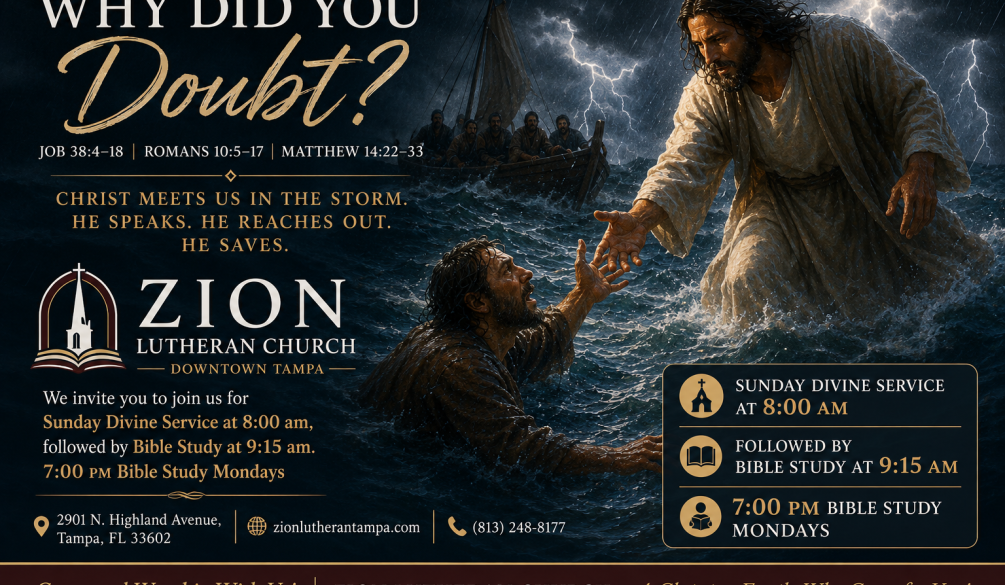
“Why Did You Doubt?”
Job 38:4–18; Romans 10:5–17; Matthew 14:22–33
May 13, 2025
Dear beloved members and dear friends of Zion,
If you’ve been searching for a Conservative church in Downtown Tampa where the Word of God is taken seriously and Christ is at the center of everything, I want to personally welcome you. Here at Zion Evangelical Lutheran Church, a Lutheran Church near Ybor Tampa, we gather as a family-friendly church in Downtown Tampa to receive the gifts God so freely gives.
Beloved in the Lord, you heard the question. Jesus asks Peter, “Why did you doubt?” It is a question that echoes across all three readings today. It is the question the Lord presses upon Job from the whirlwind. It is the question Paul answers in Romans as he proclaims the certainty of faith that comes through hearing the Word of Christ. And it is the question that confronts us in our own storms, fears, and uncertainties.
This question is not meant to shame. It is meant to reveal. It exposes the fragile, sinful human heart, which so easily forgets the presence and promises of God. Yet it also reveals the steadfast mercy of the Lord, who meets doubters with His Word, His presence, and His saving hand.
I. The Storm Before the Storm: Feeding the 5,000
Matthew tells us in our Gospel reading, that Jesus “Immediately, . . . made the disciples get into the boat” (Matthew 14:22, ESV). However, remember that “immediately” prior to this command, something extraordinary had taken place. Jesus had fed the 5,000. The disciples watched Him take five loaves and two fish, bless them, break them, and multiply them until every person was fed and every person was satisfied. And, O, by the way, the disciples gathered up twelve baskets of leftovers.
They had just witnessed divine power—creative power—power to satisfy scarcity, hunger, and human need. They had seen a miracle that echoed the manna in the wilderness and pointed forward to the new covenant in the Lord’s Supper.
Yet Jesus sends them away immediately. Why? We learn from St. John that the crowd wanted to take Jesus by force and make Him their king. Jesus does not want His disciples to be stirred up by the wrong kind of expectation. Plus, if you remember, Jesus came to this desolate place to be by Himself to pray. John the Baptist had just been killed. So, Jesus sends them into the boat, into the night, into the storm. Jesus is teaching them something deeper than the miracle of bread.
Jesus is teaching them who He is.
II. Job’s Storm: “Where Were You?”
God’s servant, Job, knew storms as well. His calamities were overwhelming—loss of health, loss of livelihood, loss of his family. Job’s friends offered misguided advice, insisting that suffering must be punishment. Job cried out in confusion, frustration, and anguish.
And as we heard this morning, the Lord answered him—not with explanations, but with questions.
“Where were you when I laid the foundation of the earth?” (Job 38:4, ESV)
“Have you commanded the morning since your days began?” (Job 38:12, ESV)
“Have the gates of death been revealed to you?” (Job 38:17, ESV)
O, my! These questions may sound sarcastic and even cruel. Indeed, they are very humbling. They are corrective. They reorient Job’s vision. They remind him that the One who governs creation also governs his life. The One who sets boundaries for the sea also sets boundaries for suffering. The One who knows the depths of the earth also knows the depths of Job’s pain.
Dear brothers and sisters in Christ, as much as Job suffered—Job’s problem was not that he suffered. His problem was that he doubted the Lord’s presence in his suffering.
And who could blame him?
Yet the Lord does not abandon Job. He speaks. He reveals Himself. And, ultimately, Job responds:
“I know that you can do all things… therefore I despise myself, and repent in dust and ashes.” (Job 42:2, 6, ESV)
Job’s repentance is not despair. It is the surrender of his doubt before the Almighty God. It is Job’s restored trust in God that had been smothered in suffering and grief and confusion and DOUBT. Do you get it?
III. Peter’s Storm: “Take Heart; It Is I.”
Back on the Sea of Galilee, the disciples are battered by waves. The wind is against them. They are exhausted, terrified, and alone—or so they think. Then Jesus comes to them, walking on the water.
The One who multiplied bread now tramples the waves. The One who created the seas, and ALL things, now strides upon them. The One who commands the morning now approaches in the fourth watch of the night.
And Jesus speaks: “Take heart; it is I. Do not be afraid.” (Matthew 14:27, ESV)
The Greek phrase ego eimi—“it is I”—is the same phrase used in the Greek when God reveals Himself as I Am. Jesus is not merely comforting them to quiet their fears. He is revealing His divine identity.
You heard the account. Peter boldly challenges this ghostly figure, “Lord, if it is you, command me to come to you on the water.” (Matthew 14:28, ESV) “Come!” Jesus replies. And Peter did! Peter steps out of the boat. Peter walks on water! For a moment, faith holds him. But then he feels the wind and sees the waves. He doubts. He sinks. “Lord, save me!”
And Jesus immediately reaches out His hand.
Immediately. Not eventually. Not reluctantly. Immediately.
“O you of little faith, why did you doubt?” (Matthew 14:31, ESV)
It can be said that this is not a scolding or a condemnation. It is, most certainly, a question that reveals the heart of faith. Peter doubted because he looked at the storm instead of the Savior. He doubted because he trusted his senses more than the Word. He doubted because he forgot the One who fed the 5,000, who walked on water, who is the great I Am.
IV. Why Did Peter Doubt? Faith as Gift and Growth
Peter’s doubt is not surprising. Like Job, Peter is a man in process. Faith, the free gift of faith, is given by the Holy Spirit in a moment—punctiliar—as Paul teaches:
“So faith comes from hearing, and hearing through the word of Christ.” (Romans 10:17, ESV)
Yet the life of faith, our faith journey—if you will, is also a continual formation, a daily dying and rising, a growth worked by the Word of God. The Bible says, Therefore let us leave the elementary teachings about Christ and go on to maturity…(Hebrews 6:1a NIV)
Peter’s life demonstrates this beautifully.
1. The free gift of Faith Begins by the Word
Peter follows Jesus because Jesus speaks: “Follow me.” (Matthew 4:19, ESV) The Bible says, Immediately, they left their nets and followed Him.
As world acclaimed theologian Francis Pieper writes: “The Word of God is not a dead letter, but truly the power of the Holy Spirit.” (Pieper, Christian Dogmatics, Vol. I, p. 108–109)
2. Secondly, in Peter’s faith journey, we see that Faith Falters When Our Eyes Leave Christ.
In our reading this morning, Peter walks on water because Jesus says: “Come.” (Matthew 14:29, ESV) And he does! But when Peter feels the wind, when he takes his eyes off Jesus, he doubts. He sinks in his doubts and fears.
The Word creates faith; fear distracts from it.
3. Faith Grows Through Revelation
By now, Peter has seen and heard and experienced numerous faith-building revelations. So much so, that when Jesus asks, “Who do people say that the Son of Man is?”, Peter confesses: “You are the Christ. The Son of the Living God!” (Matthew 16:13, 16, ESV)
Jesus responds: “Flesh and blood has not revealed this to you, but my Father who is in heaven.” (Matt 16:17, ESV)
Faith grows because God reveals Himself to us through His Holy Word.
4. Faith Is Unassuming
By that I mean that we can easily impose OUR will over the direction that faith would lead us. Again, we learn from Peter’s faith journey. Jesus was teaching His disciples that He must suffer and die. Peter and the disciples did not like that prospect! Peter said, “Far be it from you, Lord!” (Matthew 16:22a ESV)
Do you remember how Jesus rebuked Peter? “Get behind me, Satan!” (Matthew 16:23, ESV)
Faith is unassuming in that we can still impose our stubborn human-will over it.
5. Faith Falls Under Fear
Peter was so fearful that he, too, would be crucified that he denies Jesus three times. Yet Jesus, prior to Peter’s triple denials told Peter, “I have prayed for you that your faith may not fail.” (Luke 22:32, ESV)
Christ sustains our faith even when our fears suffocate our faith.
6. Faith Is Empowered by the Spirit
At Pentecost, Peter preaches boldly: “This Jesus, whom you crucified, … God raised him up.” (Acts 2:32, ESV)
The doubter becomes the preacher. The Word has done its work.
V. God Secures His Children by His Word
Turning again to Pieper:
“God preserves His children by His Word, for the Word is the almighty, creative, and sustaining power of God Himself. As the Word called the world into existence, so it calls faith into being, keeps it, strengthens it, and brings it to completion.” (Pieper, Christian Dogmatics, Vol. I, p. 112–113; Vol. II, p. 27–28)
This, then, is our comfort: When, not if, we doubt, God’s Word secures us. When, not if, we falter, Christ’s hand rescues us. When, not if, we fear, the great “I Am” speaks peace.
VI. The Gospel Predominates: Faith Comes by Hearing
“Faith comes from hearing, and hearing through the word of Christ.” (Romans 10:17, ESV)
Christ meets us in the storm. Christ speaks into our confusion. Christ reaches out His hand. Christ is the great I Am. And faith comes by hearing Him.
God grant it for Jesus’ sake. Amen.
No, in all these things, we are more than conquerors through Christ, who loved us (Romans 8:37, ESV)
Come and Worship With Us
When doubt comes, when fear rises, and when the storms of life seem to overwhelm us, Christ does not abandon His people. He speaks His Word. He reaches out His hand. He strengthens our faith and reminds us that He is with us.
If you are looking for a Conservative Church in Tampa, a Lutheran Church near Ybor City, or a Family-friendly church in Tampa, we invite you to join us at Zion Lutheran Church. Come hear God’s Word clearly, receive His gifts faithfully, and be strengthened in the faith that comes through hearing the Word of Christ.
Come and worship with us this Sunday. Bring your questions, your fears, your doubts, and your burdens. The Lord meets His people with grace, truth, and mercy.
Zion Lutheran Church — A Christian Family Who Cares for You!
Download the Worship Folder