
The Lord Alone Governs All Things
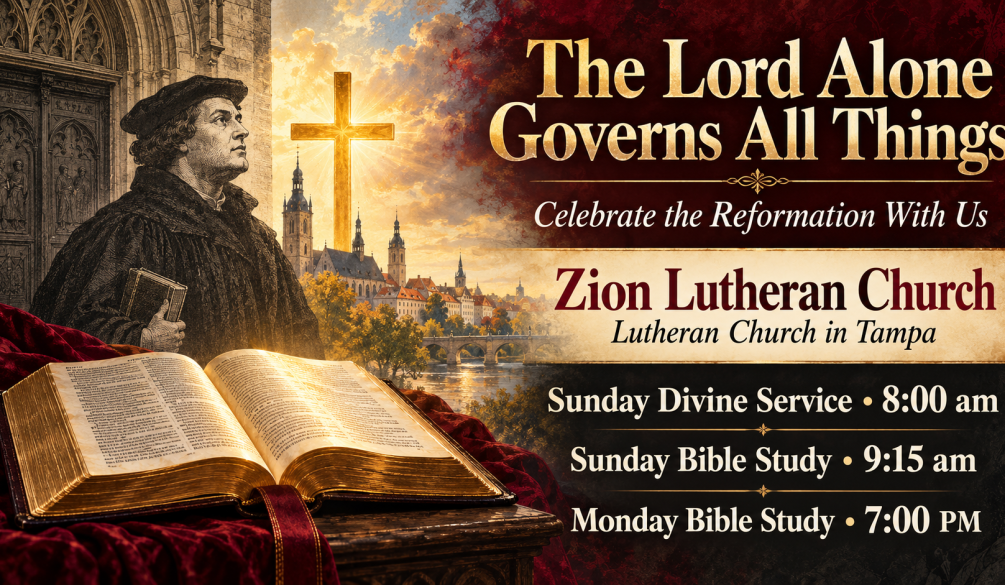
If you are looking for a Conservative Church in Tampa or a Lutheran Church in Tampa, Zion Lutheran Church invites you to hear the comfort and hope of God’s Word. In this sermon, Rev. Kenneth Redmann reflects on God’s rule over all things and the assurance that, through Christ, we belong to Him.
Oct 18 21PentAG Rev. Kenneth Redmann
Opening Prayer
May the meditations of our hearts and the words of my lips be acceptable to You, O Lord. Amen. In the name of the Father and of the Son and of the Holy Spirit. Amen.
The Lord Alone Is in Total Control
Today’s appointed readings combine to confront us with a truth that can be described as “mind-boggling.” God’s mysterious revealed truth is humbling and comforting. That TRUTH is: the Lord alone governs all things; or reigns over all things; or the Lord alone is in total control over all things at all times and under every circumstance. I know! I know! It is hard to believe.
Yet, as we shall see, God governs kings and nations, He governs history and time, He governs the lives of His people, AND He governs His Church universal and His local Church—yea, even Zion Evangelical Lutheran Church in Tampa Heights, FL.
And because He governs all things, Jesus teaches us to “render to Caesar the things that are Caesar’s, and to God the things that are God’s” (Matt 22:21).
But what belongs to God? The answer, drawn from Scripture and affirmed by the Church through the ages, is simple and profound: YOU belong to God.
I. We have said that: God Governs All Things—Even When It Surprises Us
Our Old Testament reading from Isaiah 45 is startling. Did you catch it? “Thus says the LORD to His anointed, to Cyrus…” (v1). Cyrus is a pagan king from Persia. YET, the Lord says to Cyrus: “I call you by your name, I name you, though you do not know me.” (Isa 45:4)
Cyrus does not worship the Lord. He does not know the Lord. Yet the Lord knows him, raises him up, and uses him to deliver His people.
So, here is the thumbnail sketch: Jerusalem has been decimated. Her walls of protection completely demolished. Her magnificent temple has been ransacked and desecrated. The seventy years of Babylonian captivity is drawing to an end. God is now raising up Cyrus, the King of Persia to overthrow Nebuchadnezzar, the King of Babylon—for the purpose of setting God’s Chosen People free and restoring them to Jerusalem.
Dare I say it? Bear with me, please. They are the original Remnant in Rebirth.
Beloved in the Lord, God’s sovereignty is not theoretical—it is concrete, historical, and sometimes very surprising.
The psalmist proclaims: “For great is the LORD, and greatly to be praised; he is to be feared above all gods” (Ps 96:4). The Lord reigns over all nations, all peoples, all rulers, all powers.
Paul writes to the Thessalonians that the Gospel came to them “not only in word, but also in power and in the Holy Spirit” (1 Thess 1:5). God governs not only kings and nations—He governs hearts.
In our Gospel lesson, Jesus reveals that God’s claim on us is ultimate. Caesar may have a legitimate claim on the coin that bears his image, but God has a far greater claim on the human being who bears His image—fractured as it now is.
II. And because of our fallen state, We Resist God’s Rule.
1. We want control over our lives.
Isaiah reveals God using Cyrus—someone Israel never would have chosen. God’s ways are not our ways (Cf Is.55:8-9). We prefer a God who works according to our expectations, who governs in ways we approve, who uses the people we would choose.
But God says: “I form light and create darkness; I make well-being and create calamity; I am the LORD, who does all these things.” (Isa 45:7)
We resist this. We don’t understand how a God of Love can “create calamity.” We want to be sovereign over our own lives.
2. All too often, we give to Caesar what belongs to God.
The hypocritical Pharisees try to trap Jesus with a political question. They want to force Him into choosing sides. Jesus refuses. Jesus acknowledges Caesar’s legitimate authority, (granted to Caesar by God in the first place), but Jesus refuses to let politics define the kingdom of God.
We often do the opposite. We let earthly loyalties overshadow our loyalty to God. We give our hearts, our fears, our hopes, our identity to earthly powers—things that belong to God alone.
3. We worship idols of the heart.
Psalm 96 declares: “For all the gods of the peoples are worthless idols.” (Ps 96:5)
Luther writes in the Large Catechism, “Whatever you set your heart on and put your trust in is truly your God.” Our idols may not be statues, but they are real: control, comfort, politics, money, reputation, self‑rule.
4. We fail to render ourselves to God.
The denarius bears Caesar’s image, and so it is rightly given back to Caesar. But we — human beings — were created to bear God’s image (Gen. 1:27). That image, in its proper sense, was original righteousness: true knowledge of God, fear of God, trust in God, and a will aligned with God’s will. Sadly, tragically, through the fall of Adam and Eve, that image was lost, and what remains in us now are only the damaged remnants of it — reason, will, and relational capacity, all bent inward by sin.
Instead of giving ourselves to God in trust and obedience, our corrupted nature clings to self-rule. We withhold from God what is rightfully His: our hearts, our worship, our lives, our gifts and talents. We were made to reflect His righteousness, but in our sin we render ourselves to anything and everything except Him.
III. In spite of the gravity of all of this—the Gospel reveals the astonishing truth: God Governs All Things for Our Salvation.
1. God governs HISTORY to bring salvation.
Our Old Testament lesson from Isaiah 45 shows God directing kings and nations so that His people may be saved. Francis Pieper writes that God’s providence is always directed toward the good of His Church. Even pagan King Cyrus becomes an instrument of God’s grace.
2. God governs the Gospel to reach us.
Paul says the Thessalonians “turned to God from idols to serve the living and true God” (1 Thess 1:9). They did not find God—God, through the Holy Spirit, found them. He turned them from idols to Himself.
3. God governs redemption through Christ.
Jesus does not merely teach ABOUT rendering to God—Jesus renders Himself to God FOR US. Jesus gives to the Father what we could never give: perfect obedience, perfect trust, perfect worship, perfect surrender.
Jesus bears the image of God perfectly (Col 1:15) and restores that image in us through His death and resurrection. Hear the Word of the Lord, “you [Christians] have put off the old self with its practices and have put on the new self, which is being renewed in knowledge after the image of its creator” (Col 3.10).
4. Dear brothers and sisters in Christ, God claims you as His own.
Because Christ has redeemed us, God says: “You are mine.” Luther writes in the Small Catechism that Christ “has redeemed me a lost and condemned creature… that I may be His own.” The Gospel is not merely that God governs all things—it is that He governs all things for the sake of His redeemed people.
IV. Sanctification: Therefore, We Render Our Lives to God
Sanctification, i.e. the living of our lives, flows from the Gospel—not from fear, pressure, or political anxiety, but from belonging to Christ.
1. We render worship to God alone.
“Ascribe to the LORD the glory due his name” (Ps 96:8). Because God reigns, worship becomes our joyful response—not a burden.
2. We render obedience to God in our vocations.
Jesus affirms legitimate earthly authority: “Render to Caesar the things that are Caesar’s.” Luther and the Confessions teach that Christians honor rulers as part of their vocation (Augsburg Confession XVI). But we obey God above all when earthly claims conflict with His Word.
3. We render witness to God before the world.
The Thessalonians became “an example” to all believers. Their faith “sounded forth” (1 Thess 1:7–8). Living our Christian faith is not private—it is visible.
4. We render ourselves to God daily.
Because we bear God’s image, we give Him our hearts, our decisions, our time, our resources, our vocations, our worship—our whole selves. Not to earn salvation, but because salvation is already ours.
5. And finally, we render trust to God in uncertain times.
The fact that God used the pagan, King Cyrus, teaches us that God works through unexpected means. We trust His governance even when we cannot see His plan. Another way to say this is, the Lord alone is in total control over all things at all times and under every circumstance.
Therefore: Render to Caesar what is Caesar’s. Render to God what is God’s. And remember—what is God’s is you.
God grant it for Jesus’ sake. Amen.
“For I know the plans I have for you,” declares the Lord, “plans for welfare and not for evil, to give you a future and a hope” (Jer 29.11 NIV).
Join Us for Worship and Bible Study
Find encouragement in God’s Word and join our church family at Zion Lutheran Church. You are invited to Sunday Divine Service at 8:00 am, followed by Bible Study at 9:15 am. We also welcome you to 7:00 PM Bible Study Mondays as we grow together in faith and understanding of Scripture.
Prepare for worship by downloading the October 25 Reformation Day worship folder. We look forward to welcoming you!
Zion Lutheran Church — A Christian Family Who Cares for You!