
Paul and the Providence of God
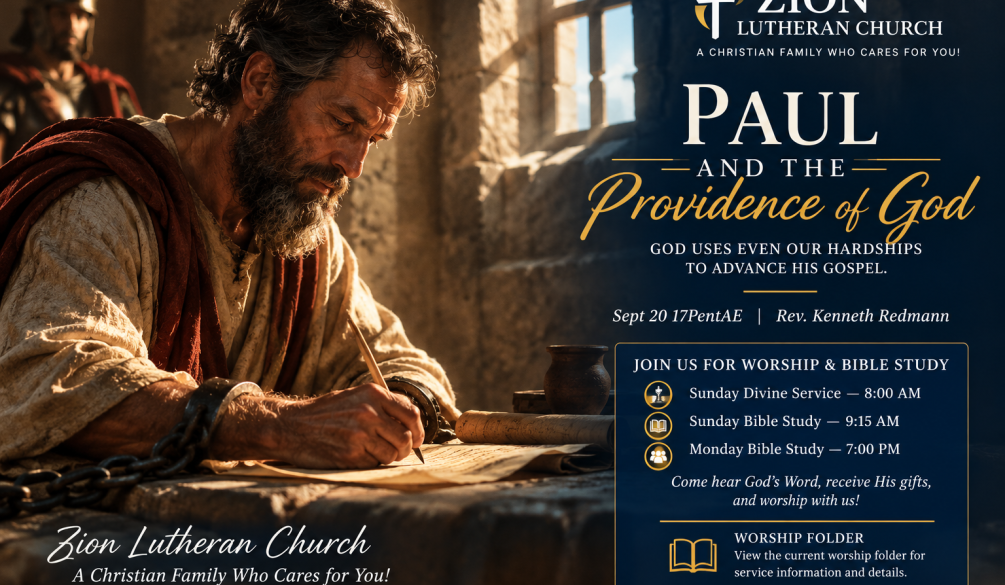
If you are searching for an LCMS Lutheran Church in Tampa or a Conservative Church in Tampa, Zion Lutheran Church welcomes you to explore the Word of God with us. In this sermon, Rev. Kenneth Redmann reflects on Paul, suffering, Christian steadfastness, and the Providence of God through the opening chapter of Philippians. As Paul discovered, even difficult circumstances can serve the advancement of the Gospel according to God’s providential care.
Sept 20 17PentAE Paul
May the meditations of our hearts and the words of my lips be acceptable to You, O Lord. In the name of the Father and of the Son and of the Holy Spirit. Amen.
Dear brothers and sisters in Christ, dear Remnant in Rebirth, last week we stood with Joseph in Genesis 50:20 and heard him proclaim: “You meant evil against me, but God meant it for good.” And in one of the most widely quoted verses in all of the Bible, we hear Paul, inspired by the Holy Spirit, echo the same truth in Romans 8:28: “And we know that for those who love God all things work together for good, for those who are called according to His purpose.”
Today, we begin a four‑week journey through the appointed Epistle readings. In doing so, we will discuss the entire letter that Paul, inspired by the Holy Spirit, wrote to the young Christians in Philippi.
Our theme for today is, Paul and the Providence of God. The Providence of God? Yes. And you may well ask, “What exactly is the Providence of God?” Turns out, that is a really critical question!
I asked Google! You know, Google knows everything!
Google said that the Providence of God is: the foreseeing care, guidance, and benevolent superintendence which God exercises over the universe and all human beings. And I am like: O-K-A-Y!
Francis Pieper, in his Christian Dogmatics, does NOT so much define the Providence of God as much as he describes it.
God, who created the world, also preserves it. Colossians 1:16-17: All things were created by Him…and in Him all things hold together (ESV). We call this act, … the divine Providence, which means that God actually preserves and governs the universe and ALL individual creatures. (Christian Dogmatics, 1953, electronic ed., Vol 1, pp. 481. CPH).
Pieper goes on to explain:
After creating the world, God did not withdraw from it, …but He remains in contact with the world and sustains everything in it, the greatest and the least, by His divine power. … If God would desert the world, it would at once disappear. If God would withdraw His presence from any part of the world, that part would cease to exist.
Thus, Paul understood that God remains intimately engaged in the world to work all things to the glory of His Kingdom. God does not desire that one (not one!) created one should perish.
Thus we see the Providence of God shining through the chains of the Apostle Paul. In Philippians 1:12, Paul begins his letter with a stunning declaration: “I want you to know, brothers, that what has happened to me has really served to advance the gospel.” (ESV)
What has happened to him? Arrest. Imprisonment. Trial. Uncertainty. Hardship. Suffering.
Yet Paul says it has really served to advance the gospel.
Today we ask: Why is Paul so steadfast? What does Paul understand that makes him rejoice in chains? What does he know about Jesus that compels him to serve with his whole life?
And then we ask: What does this mean for us — the Remnant in Rebirth — a 100‑year‑old mission start, small in number but rich in heritage, called anew to the work of the Gospel?
I. In pondering Paul and the Providence of God, Scripture interprets Scripture and our readings from Isaiah and Matthew Set the Stage
(A. Isaiah 55: God’s Ways Are Higher)
Our Old Testament reading lays the foundation:
“Seek the LORD while he may be found… For my thoughts are not your thoughts, neither are your ways my ways, declares the LORD.” (Isaiah 55:6, 8 ESV)
God’s ways are higher — higher in mercy, higher in grace, higher in generosity. You know, we recite it every Sunday. Exceeding abundantly above all that we ask or think or imagine—higher! This is the theological soil in which Paul’s confidence grows.
(B. Matthew 20: The Generous Master)
Jesus’ parable of the laborers in the vineyard reveals the heart of God’s providence. Some work ALL day. Some work only one hour. Yet the master gives the same wage to all.
The point is not fairness. The point is grace. The point is God’s sovereign freedom to be generous. The point is God’s providence, which gives not according to merit but according to mercy.
This is what Paul understands. This is why Paul is steadfast. This is why Paul is willing to suffer, to endure, to die.
Paul has come to know the generosity of God in Christ. He knows that everything — chains included — comes from the hand of a gracious Master.
(II. Paul’s Captivity: The Historical Setting)
Theologian, Harlyn Kuschel, in his People’s Bible Commentary on Philippians, helps us understand Paul’s circumstances. Paul is imprisoned, likely in Rome but possibly in Caesarea. Wherever he is, he is under house arrest, chained to Roman guards, awaiting trial before Caesar. His future is uncertain. He may be set free. He may be executed.
Yet Kuschel emphasizes that Paul is not discouraged. He is not defeated. And he certainly is not silenced.
Instead, Paul sees his imprisonment as part of God’s providential plan. The guards hear the Gospel. Visitors hear the Gospel. Roman Christians are emboldened. The Gospel spreads in ways it never would have if Paul were free.
Paul’s chains become Christ’s pulpit.
This, then, is one example of the astonishing reality of God’s Providence: God uses suffering to advance His saving purpose.
(III. Paul’s Unwavering Devotion to Christ)
Paul’s words in Philippians Chapter 1, reveal a man utterly captivated by Christ. He writes:
“It is my eager expectation and hope that I will not be at all ashamed… For to me to live is Christ, and to die is gain.” (Philippians 1:20–21 ESV)
This is not stoicism or bravado. This is not fatalism or resignation.
This is faith — faith in the crucified and risen Lord who loved Paul first.
(A. Luther: Life Under the Cross)
Luther teaches that the Christian life is lived under the cross — the Church Militant. Suffering is not a sign of God’s absence but of His work. Paul’s chains are not obstacles; they are instruments. Suffering is part of the battle Christ wages through His Church.
(B. Pieper: Providence and Preservation)
Pieper emphasizes that God’s Providence is not abstract. It is personal. It is purposeful. It is directed toward the salvation of all people and the preservation of His Church.
Paul’s imprisonment is not an accident. It is not a failure. It is not a defeat.
It is God’s providential means of advancing the Gospel.
(C. Walther: The Gospel Produces Courage)
Walther teaches that the Gospel — not the Law — produces Christian courage. The Law can and does terrify, accuse, expose — but it cannot empower and it certainly does not encourage. Paul’s strength comes from the Gospel: Christ died for him. Christ forgave him. Christ redeemed him. Christ called him. Christ promised him eternal life.
This is why Paul is unwavering. This is why Paul is determined. This is why Paul is willing to die.
He knows what Jesus has done for him. Do you get it?
(IV. Paul’s Suffering as Sanctification)
Paul writes: “I want you to know… that what has happened to me has really served to advance the gospel.” (Philippians 1:12 ESV)
Paul’s suffering is not wasted. It is not meaningless. Paul’s suffering has a purpose. Individually, it is shaping Paul into the image of Christ. But more than that, his suffering is a powerful witness and testimony.
(A. Paul’s Chains Inspire Others)
“Most of the brothers… are much more bold to speak the word without fear.” (Philippians 1:14 ESV)
Paul’s suffering strengthens the Church. His endurance emboldens others. His faith inspires courage.
(B. Paul’s Life Is Christ)
For Paul, “To live is Christ.” (Philippians 1:21 ESV) Beloved in the Lord, Christ is living in Paul. Christ is shaping and molding and forming Paul. Christ is empowering Paul. So much so, that Paul confesses, “To die is gain.” (Philippians 1:21 ESV)
This is sanctification’s final fruit: A heart so anchored in Christ that death is not loss but victory.
Dear brothers and sisters, we are not imprisoned like Paul. We are not chained to guards. We are not awaiting trial before Caesar.
But we are called to the same steadfastness. We are called to the same devotion. We are called to the same mission.
Like the early Christians in Philippi, we are small in number but rich in calling.
I certainly do not discount that we face discouragement. We face uncertainty. We face spiritual fatigue. But God’s Providence is at work in us. God’s grace is poured out on us. God’s mission is entrusted to us.
Like Paul, we say: “To live is Christ.” Paul’s chains advanced the Gospel. Our challenges can do the same. Paul’s suffering strengthened the Church. Our endurance can do the same. Paul’s unwavering devotion glorified Christ. Our steadfastness can do the same.
Because God’s ways are higher. Because God’s grace is generous. Because God’s Providence is perfect. Because Christ’s love is first — and greatest—we boldly proclaim, “To live is Christ”!
God grant it for Jesus’ sake. Amen.
16 For by him all things were created, in heaven and on earth, visible and invisible, whether thrones or dominions or rulers or authorities—all things were created through him and for him. 17 And he is before all things, and in him all things hold together.[1]
[1] The Holy Bible: English Standard Version (Col 1:16–17). (2025). Crossway Bibles.
Join Us at Zion Lutheran Church
If you are searching for a Conservative Church in Tampa or an LCMS Lutheran Church in Tampa, we invite you to join us at Zion Lutheran Church in Downtown Tampa for worship and Bible study.
Sunday Divine Service — 8:00 AM
Sunday Bible Study — 9:15 AM
Monday Bible Study — 7:00 PM
You can view the current worship folder here: Worship Folder.
We invite you to come hear God’s Word, receive His gifts, and worship with us.
Zion Lutheran Church — A Christian Family Who Cares for You!