
Forgiven to Be Forgivers
Introduction
What does it mean to be forgiven—and then to forgive others?
For Christians, forgiveness begins with the immeasurable forgiveness we have received from God through Jesus Christ. In Matthew 18, Peter asks Jesus how often he should forgive someone who sins against him. Jesus’ answer points us toward the heart of the Christian life: because we have been forgiven by God, we are called to forgive others.
If you are searching for a Lutheran church near me in Tampa, we invite you to explore what God’s Word teaches about forgiveness, mercy, and the saving grace of Jesus Christ. In his September 13 sermon, Rev. Kenneth Redmann examines Joseph’s forgiveness of his brothers, Jesus’ parable of the unforgiving servant, and the mercy of God proclaimed in Psalm 103.
We are forgiven to be forgivers.
Peter’s Question About Forgiveness
May the meditations of our hearts
and the words of my lips be acceptable to You, O Lord. In the name of the
Father and of the Son and of the Holy Spirit. Amen.
Beloved in the Lord, there is a
reason Peter asks Jesus the question he does in Matthew 18: “Lord, how often
will my brother sin against me, and I forgive him? As many as seven times?”
(v 21). Putting the best construction on it, Peter is not being stingy. A case
can be made that Peter is actually being generous by human standards. Afterall,
the rabbis taught that extending forgiveness three times was enough. Peter more
than doubles it.
However, Peter’s question reveals
something deeper: by nature, we do not want to forgive too often or too much.
We want limits. We want boundaries. We want to protect ourselves from being
hurt again. And if we are honest, we want to keep a little record of wrongs—just
in case.
But Jesus will not let Peter stay
there. Jesus will not let us stay there. Because forgiveness is not merely a
moral duty; it is the very character of the Christian life. It flows from the
heart of God Himself. And unless we understand the enormity of God’s
forgiveness toward us, we will never be able to forgive others rightly.
Today, God gives us three powerful
texts to teach us this truth: Joseph forgiving his brothers in Genesis 50,
Jesus’ parable of the unforgiving servant in Matthew 18, and the sweeping mercy
of God revealed in Psalm 103. Together they form a single message:
We are forgiven—so that we may be
forgivers.
Joseph Forgives His Brothers
Do you remember Joseph? Our text in
Genesis 50 places us at the end of Joseph’s long and painful journey. You
remember that his brothers once hated him, betrayed him, and sold him into
slavery! Now they desperately fear that Joseph will finally take revenge. The
Bible says, “It may be that Joseph will hate us and pay us back for all the
evil that we did to him” (v 15).
Their fear is understandable. They
deserve judgment. They deserve retaliation. And Joseph deserves justice.
But Joseph does something
astonishing. He weeps. He comforts. He speaks kindly to them. Joseph forgives
his brothers!
“Do not fear, for am I in the
place of God? … So do not fear; I will provide for you and your little ones”
(v 19, 21).
Joseph forgives because Joseph
knows God. Joseph forgives because Joseph has lived under God’s mercy. Joseph
forgives because Joseph understands that God has turned evil into good.
Joseph is not naïve. He does not
pretend their sin was small and inconsequential. He does not minimize the agonizing
pain he felt. He does not excuse their blatant betrayal. Joseph, if you will,
says the quiet part out loud: “You meant evil against me” (v 19). But
then Joseph explains God’s sovereignty: “But God meant it for good” (v 20).
This is right
forgiveness—forgiveness grounded in God’s mercy, not human sentiment.
Forgiveness that flows from faith. Forgiveness that sees God’s hand even in
suffering. Forgiveness that refuses to sit in the place of God.
Joseph shows us what forgiveness
looks like when we surrender in repentance and cry out to God for a new heart,
a clean heart, a pure heart that is shaped by grace. With David we pray, “Create
in me a clean heart, O God, and renew a right spirit within me (Ps 51.10).
The Enormity of God’s Forgiveness
Peter, however, has not yet come to
comprehend such Godly forgiveness. And the question for us this morning, “Have
we come to understand the enormity of God’s forgiveness?”
Peter wants a number. He wants a
limit. He wants to know when do we declare, “enough is enough!”
But Jesus answers him with a parable that explodes every human calculation. In
our Monday evening Bible class, we have examined the meaning of “hyperbole.” Hyperbole
is when we use extreme exaggeration to make a point. Jesus uses hyperbole in
His parable.
A servant owes his king ten
thousand talents—an impossible debt, a sum so large it cannot be repaid in a
thousand lifetimes. This is Jesus’ way of showing the enormity of our sin
before God.
And yet, in our parable, the king
forgives the entire debt. He releases the servant. He wipes the ledger clean.
He shows mercy beyond measure or human comprehension.
And then—that same forgiven servant
goes out and finds a fellow servant who owes him one hundred denarii—a small
debt, a few months’ wages. The first servant seizes him, chokes him, and
demands payment. He refuses mercy. He refuses patience. He refuses forgiveness.
Fellow servants reported the entire
episode to the king. The king’s judgment is swift and severe: “I forgave you
all that debt… And should not you have had mercy…?” (v 32. 33)
Jesus ends the parable with a
warning: “So also my heavenly Father will do to every one of you, if you do
not forgive your brother from your heart” (v 35). Jesus’ warning puts us in
mind of the Prayer that Jesus taught us to pray, in part, the Fifth Petition of
the Lord’s Prayer, “Forgive us our trespasses as we forgive those who
trespass against us.”
This is not works-righteousness.
Luther is clear in his Large Catechism: “Forgiveness is not earned by our
forgiving, but is given freely for Christ’s sake” (Large Catechism,
III.88).
Dear Christians, refusing to
forgive contradicts faith. It reveals a heart that has not fully embraced God’s
mercy. The unforgiving servant is not condemned because he failed to perform a
work. He is condemned because he despised God’s super-abundant grace.
Forgiven to Be Forgivers
Our theme this morning is,
“Forgiven to Be Forgivers.” How do we become forgivers? How do we forgive
seventy times seven? How do we forgive from a pure and clean heart?
The answer is found in Psalm 103—a
psalm that lifts our eyes to the enormity of God’s forgiveness.
“Bless the LORD… who forgives
all your iniquity” (v 1, 3). Not some. Not most. ALL.
“He does not deal with us
according to our sins” (v 10). “As far as the east is from the west, so
far does he remove our transgressions from us” (v 12).
Beloved in the Lord, SUCH is the
measure of God’s forgiveness. Infinite. Boundless. Complete.
“As a father shows compassion to
his children, so the LORD shows compassion…” (v13).
God forgives because He is
compassionate. God forgives because He knows our frame. God forgives because He
remembers that we are poor sinful creatures.
This is the forgiveness that Joseph
demonstrated. This is the forgiveness Peter is growing and learning to
understand. This is the forgiveness the unforgiving servant despised. And this
is the forgiveness that shapes the character of our lives as Christians.
Forgiveness and the Christian Life
World acclaimed Lutheran theologian,
Francis Pieper also insists that we are forgiven to be forgivers. Pieper
writes, “Faith which receives forgiveness is never alone; it is always
accompanied by renewal.” (Christian Dogmatics, II:558)
This renewal includes forgiving
others. Which is why Luther writes: “Where the heart is right with God… it
is impossible for it not to forgive.” (Large Catechism, III.92)
Do you get it? When Jesus warns
that the unforgiving will not be forgiven, He is not teaching salvation by
works. He is teaching that refusing to forgive is evidence of unbelief.
Refusing to forgive is a rejection of God’s abundant grace.
Therefore, forgiveness is both a
gift and a calling. We forgive because Christ forgave us. We release others
because God, through Christ, has released us. We show mercy because God
showered His mercy upon us through His only-begotten Son, Jesus.
What Does This Mean?
Today, we have been talking about:
Forgiven to Be Forgivers.
So, the famous Lutheran
question, “What does this mean?” I’m glad you asked! We start with:
·Forgiveness not optional. It is the shape of the Christian life.
·Forgiveness flows from faith, not human strength. We forgive because we have been forgiven
·Forgiveness is witness. When we forgive, we proclaim the God who forgives all our iniquity.
·Forgiveness is freedom. Unforgiveness binds; forgiveness releases.
·Finally, forgiveness is possible—even when it feels impossible—because God does not ask
us to give what He has not already given to us.
We forgive because Christ has
removed our transgressions as far as the east is from the west.
Peter asked for a number. Jesus
gave him a story. The unforgiving servant shows us what happens when we, on the
one hand, receive God’s super-abundant grace and then, on the other hand refuse
to grant forgiveness to our brother and sister. Psalm 103 shows the heart of
God who forgives all our iniquity. And Joseph shows us what forgiveness looks
like.
Beloved in the Lord, let us rejoice
that our debt is paid, our sins forgiven, our transgressions removed. Let us go
forth as people who forgive—freely, generously, from the heart—because we have
been forgiven by the God whose mercy is from everlasting to everlasting.
God grant it for Jesus’ sake. Amen.
The Lord is merciful and gracious, slow to anger and abounding in steadfast
love (Ps 103.8). Amen.
Conclusion
Forgiveness begins with the mercy of God. Through Jesus Christ, our debt is paid, our sins are forgiven, and our transgressions are removed. Because we have received such abundant mercy, we are called to live as people who forgive.
We are forgiven to be forgivers.
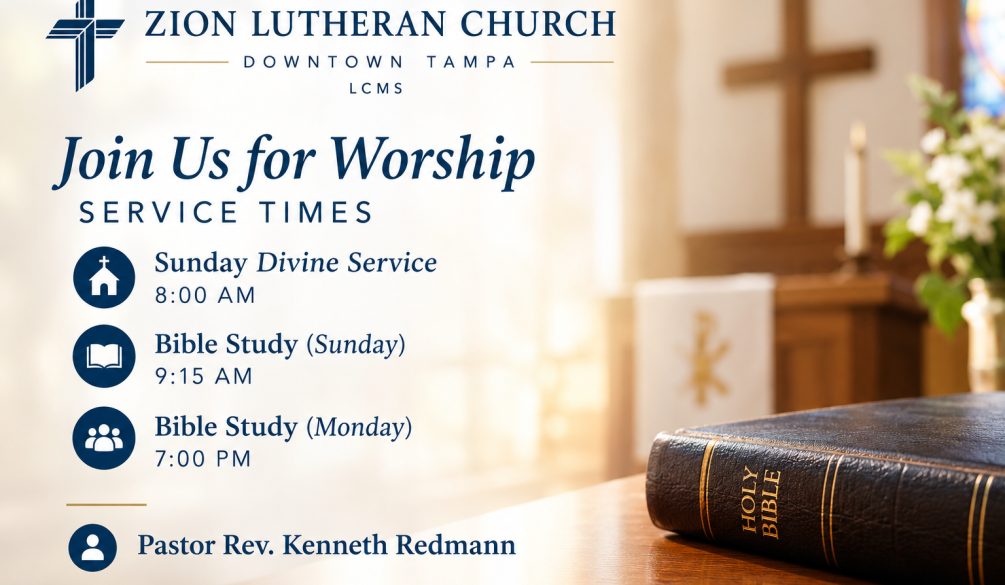
If you are searching for an LCMS church in Tampa or an LCMS church near me in Downtown Tampa, we invite you to join us for worship and Bible study as we grow together in God’s Word and in the saving grace of Jesus Christ.
Sunday Divine Service — 8:00 AM
Bible Study — 9:15 AM Sunday
Bible Study — 7:00 PM Monday
We would love to have you with us! You can also download the worship folder and follow along with the service.
Zion Lutheran Church — A Christian Family Who Cares for You!