
The Long Delay of the Bridegroom
8Nov 24PentAG Rev. Kenneth Redmann
How long, Lord? It’s a prayer many of us know by heart. We pray it when suffering lingers, when we miss someone who has died in the faith, and when we long for Christ to come again. In “The Long Delay of the Bridegroom,” Rev. Kenneth Redmann reflects on Jesus’ parable of the ten virgins in Matthew 25 and what it means to wait with confidence in Christ.
At Zion Lutheran Church, a Lutheran church in Tampa, we hear in this parable both a call to watchfulness and a promise for weary hearts. If you’re looking for traditional Lutheran worship in Tampa, this sermon offers a glimpse of the hope we hear in the Divine Service. Christ will come again, and until that day, He sustains our faith through His Word and Sacraments.
May the meditations of our hearts and the words of my lips be acceptable to You, O Lord. In the name of the Father and of the Son and of the Holy Spirit. Amen.
Wow! Here we are—nearing the end of another Church Year. The appointed readings this morning direct our eyes toward the return of our Lord Jesus Christ. For the next three Sundays, Matthew chapter 25 will stand before us like a watchman on the wall, calling us to lift our eyes beyond the concerns of this week, this month, or even this lifetime. The Holy Spirit, the watchman, is calling us to fix our eyes upon the coming Kingdom. The theme I have selected for today is, “The Long Delay of the Bridegroom.”
Today Jesus tells us a parable about ten virgins waiting for a wedding feast. You heard the teaching moment. Please remember that a parable is an earthly story with a heavenly meaning. Today, Jesus introduces ten virgins. Five are wise. Five are foolish. All ten virgins are waiting for the bridegroom.
All ten expect him to come. All ten grow drowsy. All ten sleep. And that detail is important.
The difference between the wise and foolish virgins is NOT that the wise never become weary. The difference is NOT that the wise somehow remain constantly alert while the foolish become tired. No, all ten become weary as the hours pass.
The real issue is that the bridegroom does not arrive when they expected.
As St. Matthew tells us: “As the bridegroom was delayed, they all became drowsy and slept” (Matthew 25:5, ESV).
And there we find the real tension of the parable.
The challenge is not the arrival. The challenge is the waiting.
Not the wedding feast. The waiting beforehand.
Not the return of Christ Himself. The challenge is the long years of waiting before He comes.
Beloved in the Lord, how familiar that sounds. Right? The Church has now waited for nearly two thousand years. The apostles waited. The martyrs waited. The saints waited.
Many of your loved ones waited. Your grandparents waited. Some of them died waiting. And we are waiting still. We are talking about waiting for the coming of the Bridegroom, who is Jesus.
The Psalmist captures the feelings of every believer who has ever longed for God’s deliverance: “Make haste, O God, to deliver me! O LORD, make haste to help me!” (Psalm 70:1, ESV).
That cry has echoed through every generation. “How much longer, Lord?” or “How much longer must suffering continue?” or “How much longer must death reign?” or “How much longer before we see our loved ones again?”
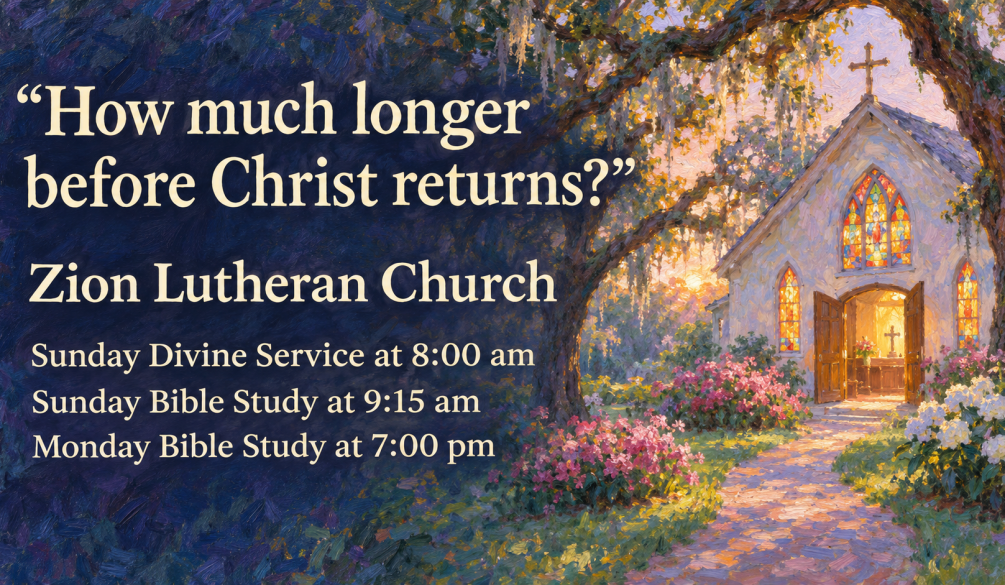
“How much longer before Christ returns?”
Beloved in the Lord, it may not sound like it—but it can be said that FAITH asks these questions. In this way we are like the man seeking healing for his demon possessed son. I am thinking about the one who cried out, “I believe. Help my unbelief” (Mk 9.24b). By FAITH, the father brought his son to Jesus. Yet, Jesus revealed that his faith was weak.
So it is with us. While the waiting continues for the Bridegroom to come, another danger is lurking, seeking whom he may devour. (Cf I Peter 5.8)
The danger is not only weariness. The danger is forgetfulness. The danger is allowing the passing years to weaken confidence in God’s promises.
That is exactly what Amos, the prophet of God, confronts in our Old Testament reading.
Israel was eagerly anticipating the Day of the Lord. They wanted judgment, but only for their enemies. They desired God’s victory but had no desire for their own repentance.
Thus Amos delivers the Word of God in sobering warning: “Woe to you who desire the day of the LORD! Why would you have the day of the Lord?” (Amos 5:18, ESV).
Israel presumed God’s grace. They assumed the future was secure while their hearts drifted far from Him. Do you get it?
Dear Christian, these same dangers remain true for us today. Many people expect heaven. Many expect to be with Christ. Many assume all is well between themselves and God. And then along comes Jesus’ parable.
Did you catch it? Jesus’ parable is addressed precisely to those who expected to attend the wedding feast. The warning is NOT first directed toward unbelievers. The warning is directed toward those WITHIN the visible Church.
The warning is directed toward us.
The holy writer to the Hebrews puts the matter plainly. Hear the Word of the Lord: “Therefore do not throw away your confidence, which has a great reward” (Hebrews 10:35, ESV).
That warning deserves careful attention. The writer to the Hebrews does NOT say:
- Do not lose your emotions.
- Do not lose your enthusiasm
“Do not throw away your confidence.” The danger before the Church is not merely weakness. The danger is abandoning confidence in Christ. The devil rarely attacks faith all at once.
The devil, the old evil foe, the Deceiver is patient. Very patient.
A little neglect of prayer and God’s Word. A little indifference toward repentance and worship. A little distance from the Sacrament.
A little MORE confidence in ourselves. A little more love for the world.
And over the months, over the years, what once seemed unthinkable slowly has become possible. The devil knows that if faith is starved long enough, unbelief, like a deadly cancer, will eventually grow.
And YET, beloved in the Lord, Jesus’ parable is not ultimately an earthly story about human failure and the five virgins who ran out of oil.
The heavenly meaning of this earthly story is the faithfulness of the Bridegroom. We learn this from St. Paul. Notice where St. Paul directs the hearts of grieving Christians in 1 Thessalonians.
They had loved ones who died before Christ’s return. Perhaps they wondered whether the promise had failed. Perhaps they wondered whether Jesus had forgotten them.
Paul’s answer is magnificent. He does not point them inward. Paul points them to Christ. Hear the Word of the Lord: “For the Lord himself will descend from heaven with a cry of command” (1 Thessalonians 4:16, ESV).
The Lord Himself. Not an angel. Not a representative or a messenger. The Lord Himself.
The same Jesus who died; who rose; who ascended into heaven.
This same Jesus who promised: “I will come again and will take you to myself” (John 14:3, ESV). Did you hear that? JESUS WILL COME AGAIN!
- He has not forgotten His promise
- He has not forgotten His Church
- He has not forgotten those who have fallen asleep in the faith
- He has not forgotten YOU!
The Bridegroom always keeps His word.
And here we are mindful of something vitally important. From our perspective the Bridegroom appears delayed. That is, after all, exactly the language Jesus uses in the parable.
Yet from God’s perspective there is no delay at all. For God, there is only perfect timing. St. Peter addresses this very concern. Some in his day mocked the promise of Christ’s return. Others grew impatient. Still others wondered why God had not acted.
Peter writes: “The Lord is not slow to fulfill his promise as some count slowness, but is patient toward you, not wishing that any should perish, but that all should reach repentance” (2 Peter 3:9, ESV).
What we call delay, God calls “the fullness of time”.
What we experience as waiting, God uses as mercy. Every additional day is another day for sinners to hear the Gospel. Another day the Spirit calls people to faith. Another day prodigals are welcomed home. Another day Christ gathers His elect.
The Bridegroom’s timing is not late. The Bridegroom’s timing is perfect. It always has been. It always will be.
So then how do we remain ready?
How do we endure until Christ comes?
The world offers its answers:
- Look within.
- Trust yourself.
- Strengthen your commitment.
- Try harder.
But Scripture directs us elsewhere.
Christian life and faith is sustained by the gifts of Christ. Hear the Word of the Lord for how the first Christians acted after the Pentecost: “. . . they devoted themselves to the apostles’ teaching and the fellowship, to the breaking of bread and the prayers” (Acts 2.42 ESV).
When Christians ask how to remain watchful, how to keep oil in our lamps, if you will, the New Testament repeatedly directs them to the ordinary means of Word and Sacraments through which God preserves faith AND grows our faith. THEREFORE:
- Hear the Word.
- Remember your Baptism.
- Receive the Lord’s Supper.
- Pray.
- Repent.
- Encourage one another in the fellowship of believers.
Beloved in the Lord, these are not merely religious activities.
These are the means of grace through which the Holy Spirit continually replenishes what is lacking.
These are not works by which we climb upward to God. RATHER, these are gifts through which God COMES DOWN to us.
God is present in a spectacular way right now in this Divine Service. Here, God strengthens weary hearts and forgives sins. Here He renews faith, comforts consciences and “keeps the lamps burning.”
The Christian life is not a sprint fueled by religious excitement.
It is a lifelong pilgrimage sustained by the means of grace.
Therefore, dear brothers and sisters in Christ, we do not lose heart.
The Bridegroom is coming.
The trumpet will sound.
The dead in Christ will rise.
The waiting will end.
Faith will become sight.
The wedding feast will begin.
And on that Day every promise Christ has ever made will prove true.
Until then, we join the cry of the Psalmist: “Make haste, O God!”
And we join the confidence of St. Paul: “So we will always be with the Lord” (1 Thessalonians 4:17, ESV).
And we rest in the promise of St. Peter: “The Lord is not slow to fulfill his promise as some count slowness” (2 Peter 3:9, ESV).
The Bridegroom is not late.
The Bridegroom is faithful.
And at the perfect moment known only to the Father, the Son shall come again in glory.
God grant it for Jesus’ sake. Amen.
“For I know the plans I have for you,” declares the Lord, “plans to prosper you and not to harm you, plans to give you hope and a future” (Jer 29.11 NIV).
The same Jesus who died and rose for us will come again. While we wait, He gives us His Word and Sacraments to forgive our sins, strengthen our faith, and comfort us in our grief. Even when the waiting feels long, we can rest in His promise that we will always be with the Lord.
If you’re looking for a Lutheran church in Tampa, we invite you to hear God’s Word and join us for traditional Lutheran worship in Tampa. Our Sunday Divine Service is at 8:00 am, followed by Bible Study at 9:15 am. You’re also welcome to join us for Monday Bible Study at 7:00 pm.
Download the November 15 worship folder to follow along with the service.
Zion Lutheran Church — A Christian Family Who Cares for You!